1 Thessalonians Questions and Answers: 25 Reading Checks
Try these 25 questions before opening the answers. They follow the inherited subjects in order while asking you to check dates, motives, translation choices and comparisons against the actual passages. Read 1 Thessalonians 1–5 first; use the chapter outline when you need a locator.
Chapter 1: Senders and Reception
1. How old were Paul and Timothy when this letter was written?
Neither the letter nor Acts supplies their birth dates or ages at composition. The opening names the three senders, but it does not support the former figures Paul 48 and Timothy 33. The USCCB introduction reconstructs Timothy’s reunion with Paul in Corinth around early summer AD 51; even that proposed year does not establish either man’s age.
2. Why write soon after the visit to Thessalonica?
The separation is painful (2:17–20), and Timothy has returned with news of faith, love and longing (3:6–10). The letter gives thanks, strengthens a community under pressure and supplies teaching about conduct, work, grief and the coming day. It does not give the exact number of months since the visit.
3. What does the gospel’s arrival in “power” mean in 1:5?
Verse 5 pairs power with the Holy Spirit and much assurance, and points to the missionaries’ conduct. Verses 6–10 then describe reception, changed allegiance and a public example. The passage does not enumerate a set of miracles in Thessalonica; a detailed miracle list would require another source.
4. What was the “much affliction” of 1:6?
The community received the word amid pressure, yet with joy in the Holy Spirit. Acts 17:1–9 describes opposition, a mob at Jason’s house and a hearing before civic rulers. First Thessalonians 2:14 also speaks of suffering from their own compatriots. These accounts give related settings without identifying every incident endured by each member.
5. What does turning from idols in 1:9 tell us about the readers?
It points to a substantial pagan background among the recipients and a change to serving the living and true God. It does not establish that every member was Gentile. Acts 17:4 names some synagogue hearers, many devout Greeks and prominent women among those who believed; the sources should not be turned into an exact demographic count.
Chapter 2: Ministry and Persecution
6. How had Paul been shamefully treated at Philippi (2:2)?
Acts 16:19–24 says the owners of an exploited slave girl seized Paul and Silas after losing their profit. Magistrates ordered them beaten and imprisoned, with their feet in stocks. Paul later protests that Roman citizens were publicly beaten without condemnation (16:37–39). See the full Philippi account for the events after the earthquake.
7. Who accompanied Paul, and why were some companions not punished at Philippi?
Silas accompanies Paul (Acts 15:40), and Timothy joins in Acts 16:1–3. The narrative switches to “we” at 16:10, commonly associated with Luke, but it does not name that speaker there. It names Paul and Silas as seized and beaten; it does not explain why Timothy or the other travelers were not. Their presumed appearance or ethnicity and Claudius’s separate expulsion from Rome are not stated causes of their exemption.
8. What do 2:4–6 say about truth, flattery and motives?
The missionaries say they were entrusted with the gospel and sought to please God, who tests hearts. They deny flattering speech, a cover for greed and the search for human glory. Read the claim alongside their labor and care in 2:7–12: it is a defense of their actual ministry, rather than a rule that every pleasant word is flattery.
9. What does the nursing-mother image in 2:7 contribute?
The KJV reads “gentle among you,” followed by a nurse cherishing her children. Verse 8 speaks of sharing their own lives as well as the gospel. The USCCB note reports the manuscript alternative “infants.” Both the textual question and the parental imagery should be acknowledged without losing the surrounding emphasis on affectionate, self-giving care.
10. Why emphasize labor and conduct in 2:9–10?
Working night and day avoided placing a financial burden on the hearers while the gospel was preached. The readers and God are called witnesses to holy, just and blameless behavior. This is an account of the missionaries’ chosen example; it is not a denial that ministers can receive support in other circumstances.
11. How does 2:14–16 compare the churches’ persecution?
The Thessalonians’ suffering from their own compatriots is compared with the Judean churches’ suffering. The USCCB note explicitly distinguishes the pagan compatriots in the first setting from the Judean opposition in the comparison. The shared experience explains solidarity in affliction; it does not establish a single ethnic cause for all persecution.
12. How should “contrary to all men” in 2:15 be read?
Verse 16 specifies the conduct at issue: hindering speech to the Gentiles so that they may be saved. This is severe polemical language about opposition to the mission, not a factual description of every Jewish person across history. The USCCB note places the passage in its immediate historical and apocalyptic setting and rejects an antisemitic inference. A catalog of unrelated Roman expulsions would not explain the sentence’s own argument.
Chapter 3: Timothy's Mission
13. Why was Timothy sent from Athens, and can we date that visit exactly?
First Thessalonians 3:1–5 says Timothy was sent to establish and comfort their faith because affliction might unsettle them. Acts 17:14–16 and 18:5 give a broader movement of companions between Macedonia, Athens and Corinth. Combining the accounts requires reconstruction; “less than six months” is not stated. Keep the purpose explicit and the exact travel interval open.
14. How did Paul respond to Timothy’s report?
The report in 3:6 concerns their faith, love and desire to see the missionaries. Paul is comforted in distress, gives thanks and prays to see them and supply what is lacking (3:7–10). These are chapter 3 references; 1:7–8 concerns their example and the spreading report about them.
Chapter 4: Holiness, Work and Hope
15. What do 4:3–7 require, and what is the “vessel” of verse 4?
The passage calls for sanctification, abstaining from sexual immorality, holiness and honor rather than lust, and avoiding wrong or exploitation. “Possess his vessel” has been read as controlling one’s body or acquiring/living honorably with a wife. The USCCB translation and note show the marriage reading and acknowledge bodily self-control. The uncertainty does not remove the shared demand for holy and non-exploitative conduct.
16. Where was Macedonia, and how does it relate to Achaia?
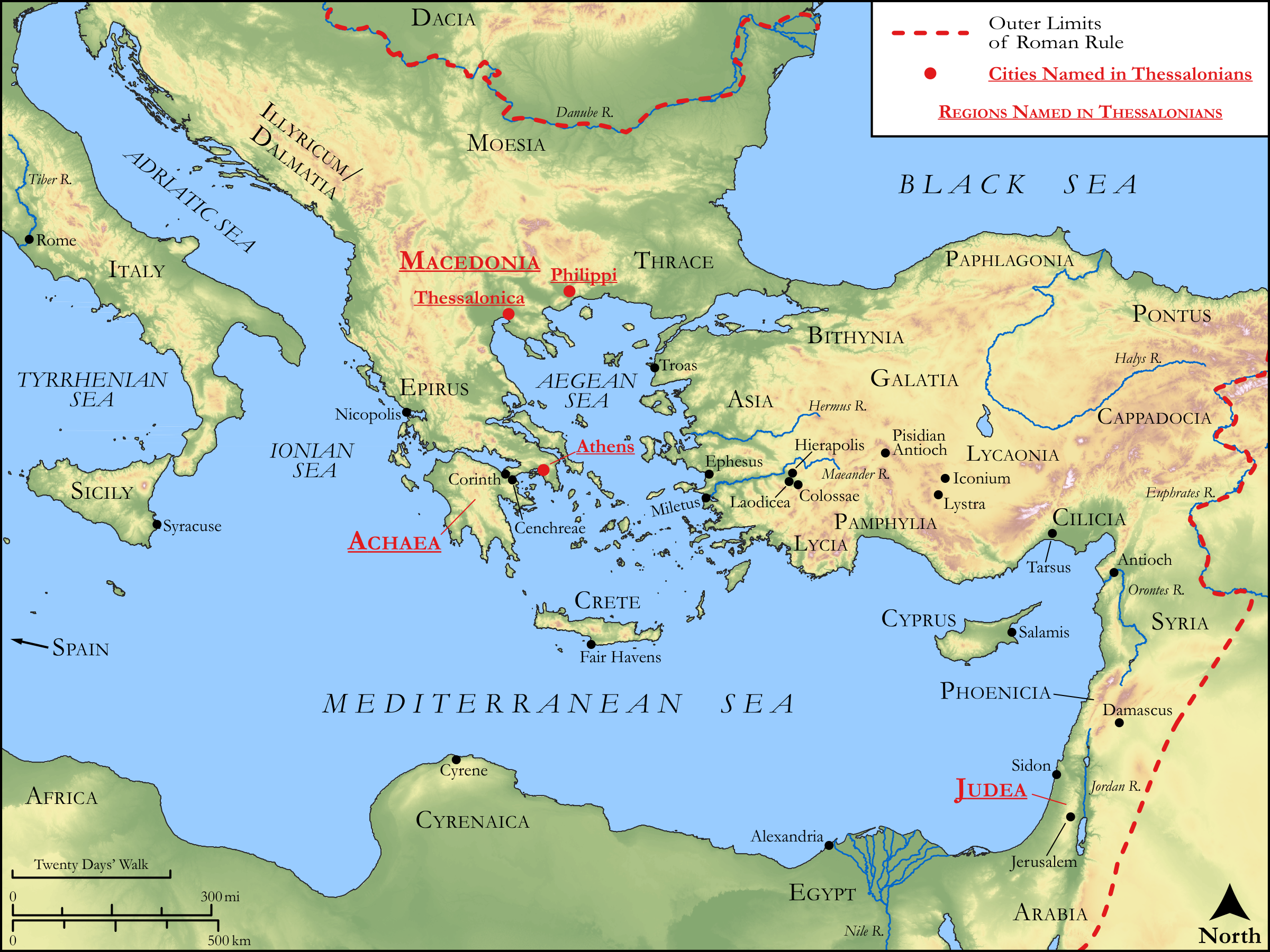
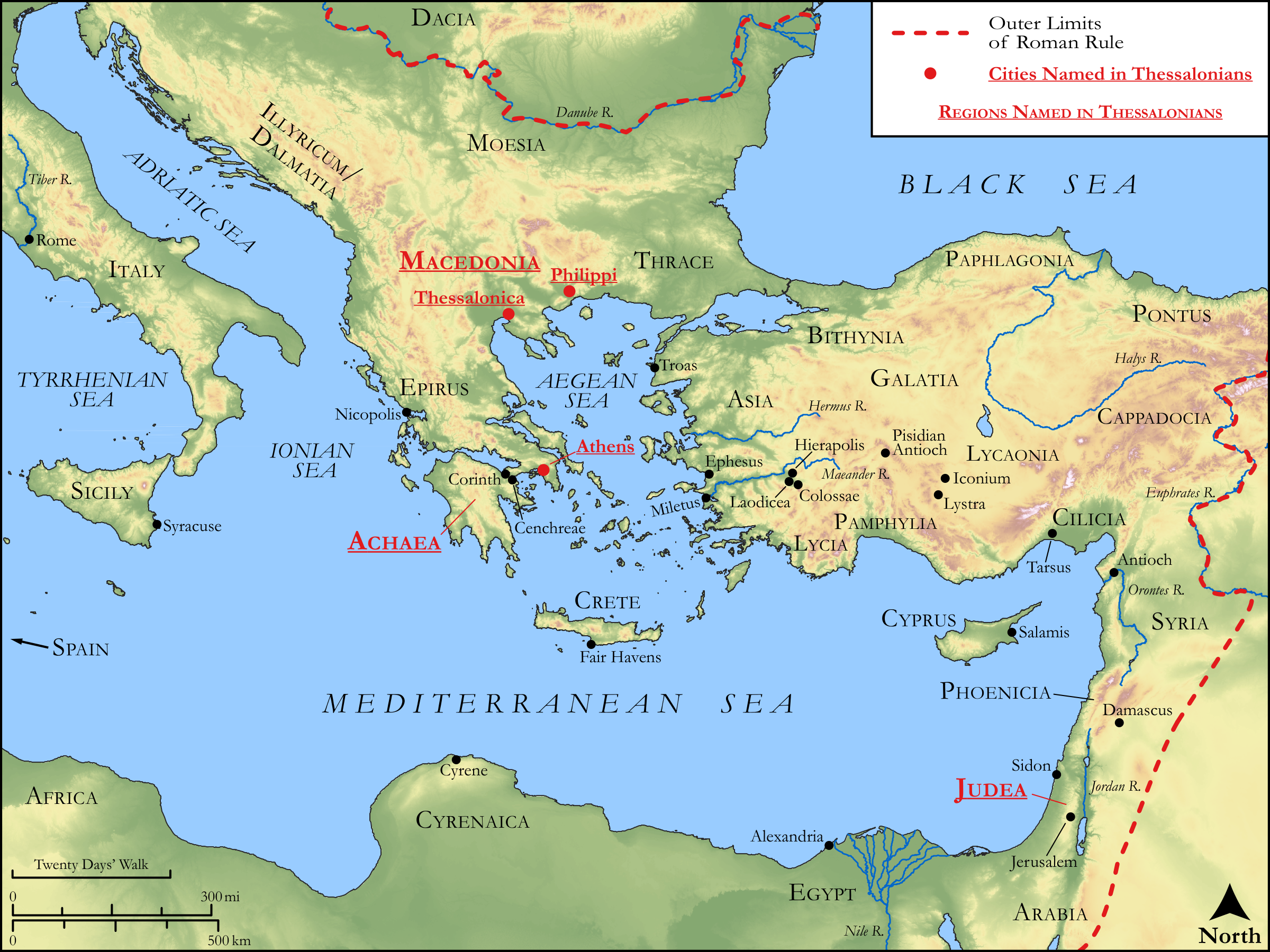
Macedonia is the northern region associated here with Thessalonica and Philippi; Achaia lies farther south, with Athens and Corinth. First Thessalonians 1:7–8 names both regions, while 4:10 speaks of love throughout Macedonia. Locate those names on the map, then use the second-journey guide for Acts’ travel sequence. This regional illustration does not fix an AD date or every ancient administrative boundary.
17. What does the quiet work of 4:11–12 involve?
Aspire to a quiet life, attend to one’s own affairs and work with one’s hands, with honorable conduct toward outsiders in view. Compare 2 Thessalonians 3:10–12, where some refuse to work and become busybodies. Neither passage makes inability to find or perform work the same as refusal, and the letters do not explicitly state every idle person’s motive.
18. Why teach about the coming and resurrection in 4:13–18?
The stated concern is grief over believers who have died. Jesus’ death and resurrection ground hope; the dead in Christ rise first, and the living join them with the Lord. The KJV’s “prevent” in 4:15 means precede, not hinder. Verse 18 calls for comfort. First Corinthians 15:12–26, 51–58 supplies a related resurrection discussion, but this paragraph does not describe every stage in a later prophetic timetable.
Chapter 5: Readiness and Community
19. What is the “day of the Lord” in 5:1–11?
It is the coming day described as unexpected like a thief, bringing sudden destruction to those relying on peace and safety. The believers are urged to be sober, to live as children of light and to encourage one another in salvation through Christ. The paragraph does not identify a calendar date, a particular Revelation seal or a modern political event.
20. How does the armor in 5:8 compare with Ephesians 6:13–17?
Here the breastplate is faith and love, and the helmet is hope of salvation. Ephesians names a breastplate of righteousness, shield of faith, helmet of salvation, truth, gospel readiness and the sword of the Spirit. The images are related, but the pairings are not identical. The Ephesians armor guide follows that longer passage.
21. How should the community regard its leaders (5:12–13)?
Recognize those who labor among them, oversee in the Lord and admonish, and esteem them in love because of their work. The instruction concludes with peace among themselves. First Peter 5:1–5 adds that elders should serve willingly and by example rather than domineer. Neither text makes a leader’s claim exempt from scrutiny, and this letter gives no exact age for the congregation.
22. What does “pray without ceasing” mean in 5:17?
It belongs with continual rejoicing and thanksgiving in 5:16–18. The same letter commends ordinary work (4:11–12) and describes labor night and day (2:9), so the instruction is compatible with practical responsibilities. It calls for persistent prayerful life; the verse does not prescribe an uninterrupted spoken formula or a fixed daily number of prayers.
23. How do prophecy and testing belong together in 5:20–21?
Do not despise prophesyings, but test everything and hold fast what is good. Openness and discernment are both required. Acts 17:11 offers a related example of examining the Scriptures rather than merely accepting a speaker’s claim. The correct reference is 5:20–21, and the testing instruction does not make every claimed revelation true.
24. Does “all appearance of evil” in 5:22 mean anything someone might dislike?
The USCCB renders the instruction “Refrain from every kind of evil.” In context it follows testing and holding what is good. The KJV wording should therefore not be made a rule that a suspicious observer’s impression alone determines guilt. It calls for refusing evil, while discernment still asks what conduct actually is.
25. What was the “holy kiss” in 5:26?
It is a greeting of affection and respect within the community. Compare Romans 16:16; 1 Corinthians 16:20; 2 Corinthians 13:12; and 1 Peter 5:14. The USCCB note describes a holy embrace, possibly within a gathering for the letter’s reading. A culturally appropriate, consensual greeting today is an application; the verse does not authorize unwelcome physical contact.
Sources and Further Reading
The complete five chapters were read in the KJV; explanations paraphrase the text except where a short quotation is identified. Cross-readings include Acts 15:22–18:28; 20:1–6; Ephesians 6:10–20; 1 Peter 5; 1 Corinthians 15:12–26, 51–58; and the greeting references named above.
- Read 1 Thessalonians 1–5 in the KJV.
- USCCB introduction: the proposed reunion in Corinth and letter occasion.
- USCCB chapter 2 and notes: gentle/infants and the context of persecution language.
- USCCB chapter 4 and notes: alternative readings of “vessel,” “precede,” and the passage's pastoral purpose.
- USCCB chapter 5 and notes: “every kind of evil” and the holy greeting.
Continue with the 2 Thessalonians outline or send corrections through our contact page.