Titus Outline: Sound Teaching, Grace and Good Works
Titus connects trustworthy teaching with the character of leaders, the conduct of a community and the grace that saves and trains it. Its three chapters move from appointing elders in Crete to teaching different groups and then to public conduct, mercy and practical needs. Read the repeated calls for good works alongside 3:5: salvation is attributed to God's mercy, not to righteous works already performed.
Use this outline to locate a passage. The separate Titus Questions and Answers: 23 Checks on the Letter preserves the detailed questions about appointments, family qualifications, KJV vocabulary and historical claims.
Background and Word Checks
Author and recipient have different roles. The letter opens in Paul's name as God's servant and Jesus Christ's apostle (1:1), and addresses Titus as his son “after the common faith” (1:4). Galatians 2:1–3 identifies Titus as a Greek who accompanied Paul and Barnabas to Jerusalem. Second Corinthians 8:23 calls him Paul's partner and fellow helper. These passages give firmer information than an assumed birthplace, conversion address or complete biography. “Son” describes their relationship in faith; it is not a statement of physical parentage.
First Timothy, Second Timothy and Titus are commonly grouped as the Pastoral Epistles because they address coworkers about teaching, conduct and leadership. That later descriptive label is useful without making Titus himself the author of the letter addressed to him.
Keep a proposed chronology separate from the instructions. Titus 1:5 says Paul left Titus in Crete; 3:12 asks Titus to come to Nicopolis when Artemas or Tychicus is sent, because Paul has decided to winter there. The letter does not name its writing year or say that Paul is already writing from Nicopolis. A subscription printed after the final verse in some KJV editions should be distinguished from 3:15 itself; the verse text counted below ends with its greeting and “Amen.” An exact AD 63 writing date and a completed post-prison itinerary require further historical argument.
| Measure | Result | Scope |
|---|---|---|
| Chapters and verses | 3 chapters; 46 verses | The chapter and verse divisions of this transcription. |
| English words | 896 | Alphabetic sequences, retaining an internal straight or curly apostrophe; headings and subscriptions excluded. |
| Exact English word “good” | 11 occurrences in 10 verses | Case ignored; related words and Greek lemmas are different counts. |
The “good” verses are 1:8,16; 2:3,5,7,10,14; and 3:1,8,14. Verse 3:8 contains the word twice. These include good character, teaching and fidelity as well as “good works”; counting every occurrence as that one phrase would misdescribe the results. A different English transcription or word rule can change a word total.
The useful reading question is how these calls fit with grace. Compare the profession denied by conduct in 1:16, the example in 2:7, Christ's redeeming purpose in 2:14 and the mercy described in 3:4–8. The letter joins salvation by mercy with the instruction that believers attend to useful works.
Map: Crete, Nicopolis and the Wider Region
Find Crete, where Titus is left to appoint elders (1:5), and Nicopolis, the requested meeting place (3:12). This map locates Nicopolis in Epirus on the western side of the Greek mainland. The black Dalmatia/Illyricum label supplies wider context for Titus's separate appearance in 2 Timothy 4:10; Dalmatia is not a place named in this letter.
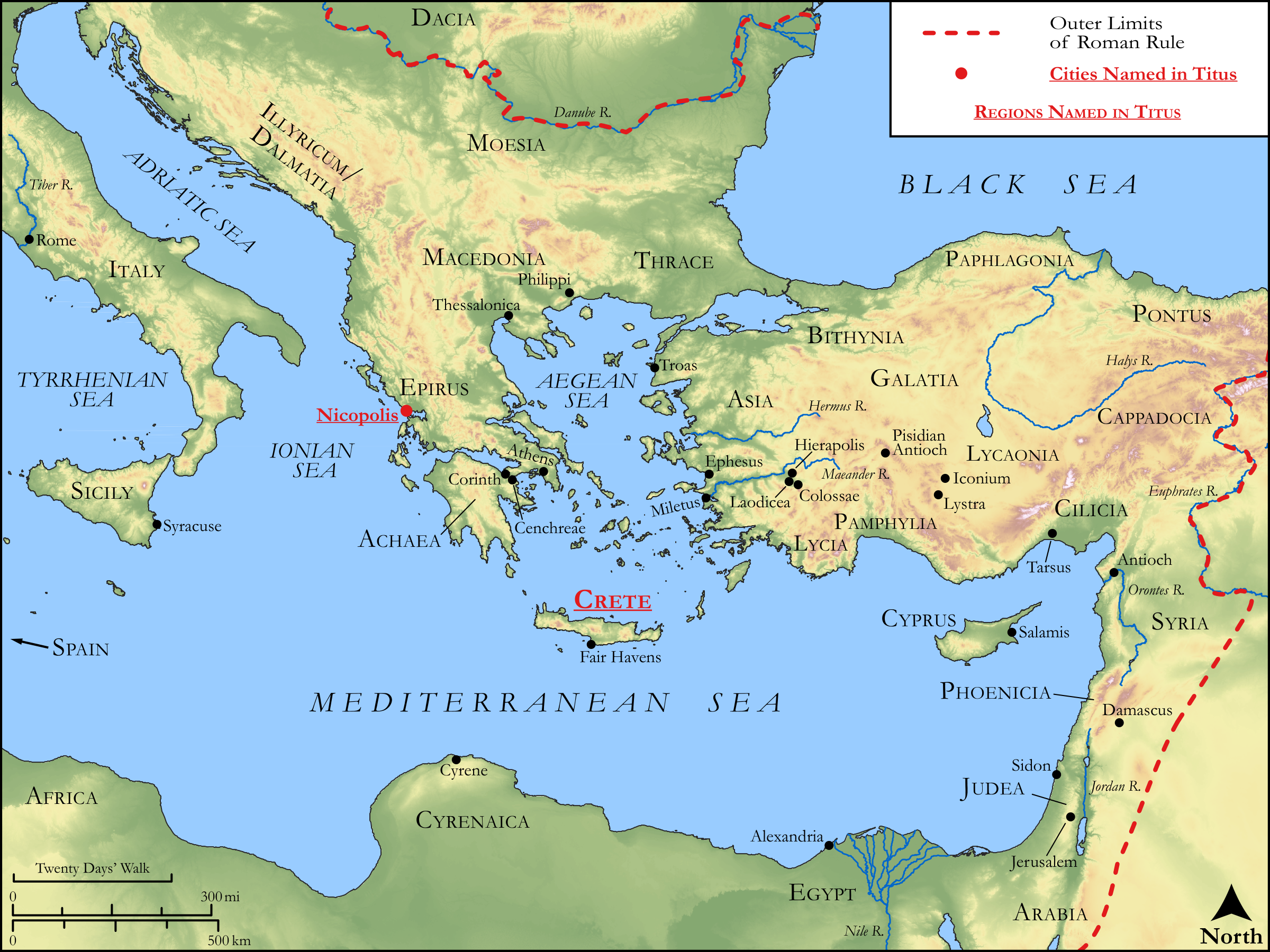

The voyage in Acts is a separate episode. Acts 27:7–16 narrates Paul's passage by Salmone, arrival at Fair Havens, the proposed winter harbor at Phenice and the later passage under Clauda. Fair Havens appears on the regional map above. For the detailed place sequence, use Paul's Journey to Rome Map and its arrival and reference-land key. The voyage account does not narrate Titus's appointment in Crete. Nor does Acts 27:9 supply the modern year or September date sometimes attached to its reference to “the fast.”
Titus 1: Greeting, Elders and Disruptive Teaching
1:1–4 — Truth, godliness and hope. The greeting connects faith and the acknowledgement of truth with godliness and the hope of eternal life. God's promise and the entrusted proclamation frame the instructions that follow.
1:5–9 — Put unfinished matters in order. Titus is to appoint elders in every city. The move from “elders” to “a bishop” links appointment with oversight and stewardship. The qualifications address household conduct, restraint, hospitality and holding the trustworthy word so as to encourage and answer opponents. For the debated application of the wife-and-children language, use question 6.
1:10–16 — Compare teaching with conduct. The opponents are described as unruly talkers and deceivers, especially those “of the circumcision.” They disrupt whole households and teach for gain. The quoted Cretan saying in 1:12 leads to the stated aim of rebuke in 1:13: soundness in faith. Jewish fables and human commands are named, but the letter does not identify them as particular stories about Lilith or seven heavens. Verse 1:16 closes with the contradiction between professing knowledge of God and denying him in works.
Titus 2: Community Conduct and Grace That Trains
2:1–6 — Teaching fitted to the community. Instructions address older men, older women, younger women and younger men. The older women teach what is good; self-control, love, fidelity and conduct that does not discredit the message recur. The KJV's several uses of “sober” represent different Greek words; question 9 separates them.
2:7–10 — Example, speech and trustworthiness. Titus himself is to model good works and integrity in teaching. The address to enslaved people concerns obedience to masters, refraining from stealing and displaying trustworthy conduct. Its social setting and vocabulary deserve attention rather than being silently converted into advice about a modern job.
2:11–15 — Why conduct matters. The grace bringing salvation has appeared and trains people to renounce ungodliness and live soberly, righteously and godly. Hope and Christ's self-giving lead to a people belonging to him and zealous for good works. Compare the KJV's “peculiar people” with Exodus 19:4–6, Deuteronomy 14:2 and 26:18, and Psalm 135:4. Here “peculiar” concerns belonging, not odd behavior.
Titus 3: Mercy, Useful Works and Closing Plans
3:1–2 — Public conduct. Submission to governing authorities stands alongside readiness for good work, restraint in speech, gentleness and meekness toward everyone. The text supplies these directions without requiring a claim about an inherited disposition of Jews or Cretans.
3:3–8 — Remember mercy. “We ourselves” once lived in disobedience and hostility. Salvation comes through God's mercy, regeneration and renewal, and justification by grace gives hope of eternal life. Verse 8 then directs believers to maintain good works. Read these together so that neither the mercy nor the practical instruction disappears.
3:9–11 — Avoid fruitless disputes and persistent division. The named subjects are foolish questions, genealogies, quarrels and disputes about the law. After a first and second warning, the factious person is to be rejected. Compare the warnings against quarrels with the patient correction described in 2 Timothy 2:23–26; a word study alone cannot supply a complete modern disciplinary procedure.
3:12–15 — People, travel and needs. Artemas or Tychicus is to be sent, Titus is asked to come to Nicopolis, and Zenas and Apollos are to receive help on their journey. The final call to meet necessary needs makes good works concrete. Greetings close the letter; the text does not report whether the requested winter meeting subsequently occurred.
Sources and Next Reading
Primary text: Titus 1–3, KJV, read in full. The defined English counts use this digital KJV corpus. Contexts checked include Galatians 2:1–10; 2 Corinthians 7:5–16 and 8; Acts 2:1–13 and 27; the stated Old Testament comparisons; and 2 Timothy 2:14–26 and 4:9–22. Regional orientation uses the credited Biblica original above; its labels do not establish an itinerary.
Continue with Titus Questions and Answers: 23 Checks on the Letter. The journey's time-marker discussion separates relative intervals from proposed calendar dates.