139 in the Bible: A Census, a Psalm and a Tabernacle Study
Ezra 2:42 records 139 members of gatekeeper families, while Psalm 139 is a prayer about being known, held and examined by God. These are two different uses of a number: one counts people and the other identifies a psalm. The passages do not assign 139 a shared symbolic meaning.
This study begins with the actual census entry, follows Psalm 139 through its difficult closing lines, and uses an illustrated tabernacle to practise checking a picture against the biblical instructions. The illustration helps with the layout of a sanctuary; it does not supply a numerical meaning for 139.
Who Are the 139 People in Ezra 2:42?
Ezra 2 opens with people returning from Babylonian captivity to Jerusalem and Judah. Verse 2 identifies them as those who came with Zerubbabel and names other leaders. The preceding chapter places the return and rebuilding of God’s house in the setting of Cyrus’s proclamation (Ezra 1:1–11). Describing this list simply as a group released under Ezra and Nehemiah obscures the setting given by the narrative.
Within the register, priests, Levites and singers have separate entries. The next entry names six gatekeeper families, using the older English word “porters”:
“The children of the porters: the children of Shallum, the children of Ater, the children of Talmon, the children of Akkub, the children of Hatita, the children of Shobai, in all an hundred thirty and nine.”
— Ezra 2:42, KJV
The six names identify the families; 139 is their combined total. It is not the number of families, and it should not be read as the number in each family. The entry also belongs to a longer register: the following verses list the Nethinim and the descendants of Solomon’s servants (Ezra 2:43–58).
Nehemiah supplies an important comparison. After describing the city’s gates and arrangements for watches, Nehemiah says that he found a genealogical register of those who had returned at the first (Nehemiah 7:1–7). The corresponding gatekeeper entry gives the same six family names, but its total is 138, not 139.
| Passage | Family names in the KJV | Total |
|---|---|---|
| Ezra 2:42 | Shallum, Ater, Talmon, Akkub, Hatita and Shobai | 139 |
| Nehemiah 7:45 | Shallum, Ater, Talmon, Akkub, Hatita and Shobai | 138 |
Neither entry explains the difference of one. A careful comparison preserves both readings instead of silently changing Nehemiah to match Ezra or inventing an account of a birth, death or missing traveller. For this page, the secure point is specific: 139 is the gatekeeper total in Ezra 2:42. The parallel passage helps us identify what is being counted and where the totals differ.
What Does Psalm 139 Say?
Psalm 139 begins, “O LORD, thou hast searched me, and known me” (verse 1, KJV). Its final prayer asks God to search the speaker again. Between those two statements, the psalm moves from daily life to the furthest imaginable places, then to life in the womb and finally to hostility toward God’s enemies. Reading that whole movement gives the familiar lines about being wonderfully made their setting.
| Verses | Movement of the prayer | Connection to the whole |
|---|---|---|
| 1–6 | God knows the speaker's movements, thoughts and speech. | The knowledge already described exceeds the speaker's understanding. |
| 7–12 | Height, depth, distance and darkness cannot hide the speaker from God. | Even at the far side of the sea, God's hand can lead and hold. |
| 13–18 | The speaker praises God's work in forming life before birth and marvels at God's thoughts. | Being known extends to the hidden beginnings of life. |
| 19–24 | The speaker rejects violent enemies of God, then asks God to examine the speaker's own heart and way. | The closing request brings scrutiny back to the person praying. |
In verses 7–12, the repeated question is where the speaker could go beyond God’s presence. The answer is nowhere in the places described. Verse 10 says, “Even there shall thy hand lead me, and thy right hand shall hold me” (KJV). Here the right hand appears in a sentence about guidance and being held. That particular action is more useful for interpreting the line than attaching a general label such as “power” to every mention of a right hand.
Verses 13–16 turn from distant places to a hidden beginning. “I am fearfully and wonderfully made” is part of praise addressed to God, surrounded by images of formation and of being seen before others could see (verse 14, KJV). The language invites wonder at God’s work; the paragraph does not give a calculation based on the psalm’s number. Verses 17–18 extend the wonder to God’s thoughts, too numerous for the speaker to count like grains of sand.
The closing section should also be read. Verses 19–22 contain severe language against those whom the speaker describes as violent and hostile to God. The prayer then turns inward:
“Search me, O God, and know my heart: try me, and know my thoughts: And see if there be any wicked way in me, and lead me in the way everlasting.”
— Psalm 139:23–24, KJV
This ending asks for more than reassurance. The person who has spoken against wickedness asks whether a wicked way may be present within the person praying. The opening “thou hast searched me” and closing “Search me” hold the psalm together. A useful reading exercise is to mark each statement about God’s knowledge, then compare it with the final request for God’s guidance.
Why Include a Tabernacle Study?
A tabernacle picture can help readers distinguish the tent itself from its surrounding court and furnishings. Its biblical starting point is Exodus 25:1–9: after instructions for willing offerings of materials, God tells Moses to have a sanctuary made so that God may dwell among the people. Verse 9 requires the tabernacle and its furnishings to follow the pattern shown to Moses. The following comparison uses those construction instructions to test the picture’s layout.
Read a Tabernacle Illustration with Exodus
The tabernacle was a tent within a larger court. Exodus 26 describes its coverings, frame and inner curtain; Exodus 27 describes the altar and the court’s hangings and entrance. Looking at these parts together helps distinguish the tent from the enclosure around it.
The coloured lithograph below is a later interpretation held by Wellcome Collection. Its numbered key identifies the court entrance, altar, washing basin, covered tent, cloud and court hangings. The surviving sheet is damaged, including a large missing strip near the lower right. Its mountains, crowd, perspective and printed theological commentary belong to the illustration; they do not establish the exact appearance of the ancient camp.
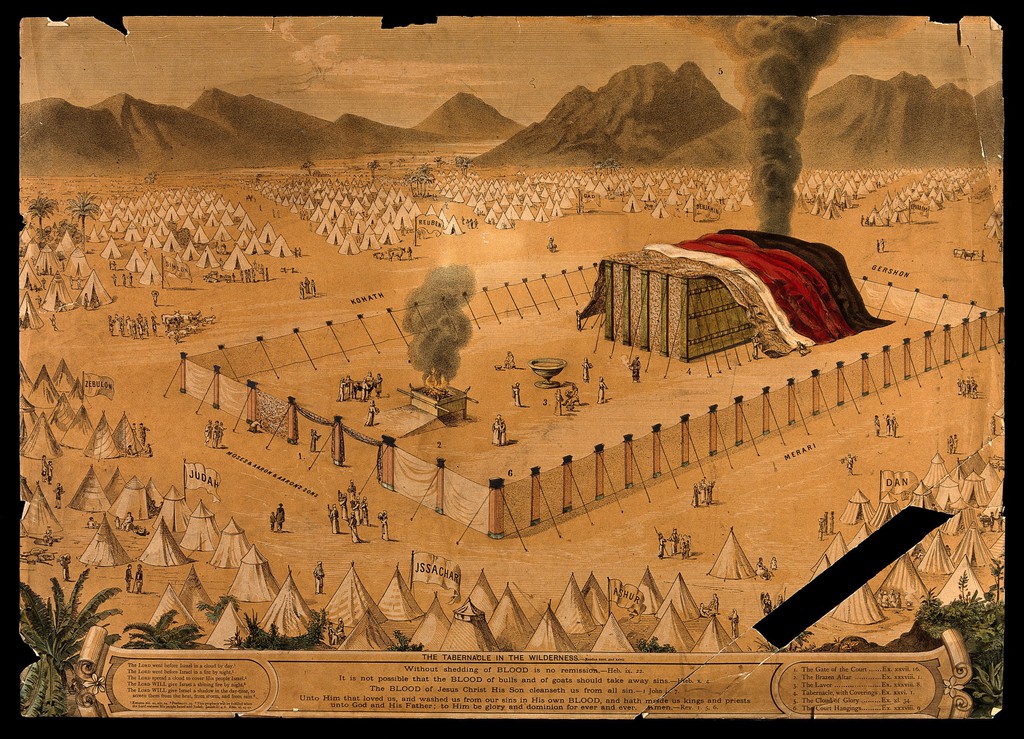
| Find in the picture | Read in Exodus | Limit of the illustration |
|---|---|---|
| The enclosure and its entrance | Exodus 27:9–18 describes the court's hangings, a 100-by-50-cubit enclosure and an entrance on its east side. | The slanting perspective is an artist's view; the picture is not a measured plan and supplies no reliable compass orientation on the page. |
| The altar and the basin beyond it | Exodus 27:1–8 describes the altar. Exodus 30:17–21 places a washing basin between the altar and the tent. | The basin has its own instruction in Exodus 30; it should not be attributed to Exodus 26–27 merely because those chapters appear in the print's heading. |
| The covered tent | Exodus 26:1–30 describes curtains, coverings and the frame; verses 31–37 describe the inner curtain and entrance hanging. | An exterior picture cannot show the inner division or establish that its colours and proportions are exact. |
Trace the route from the court entrance toward the tent, and identify which object stands between the altar and the tent in Exodus 30:18. This uses the image to compare spatial relationships. It does not make the illustration evidence for a Hebrew word-frequency total or a symbolic meaning attached to 139.
How Should These Connections Be Used?
When a number brings you to a passage, first ask what that number is doing. In Ezra 2:42, 139 is a total in a register. In “Psalm 139,” it is a reference that helps locate a prayer. A dictionary entry number such as Strong’s G139 is an identifier in a reference work; it is not an occurrence of the number 139 in the biblical sentence. A word-frequency total is yet another kind of claim and requires an identified text and counting method.
These distinctions prevent a list of numerical coincidences from replacing interpretation. For Ezra, compare the named group and the parallel register. For the psalm, follow the prayer from its first verse to its last. For the tabernacle, compare the visible objects with the instructions that describe them. Each task has evidence a reader can check without assuming that the same number makes the subjects carry one hidden message.
Sources and Further Reading
The biblical quotations on this page use the King James Version. The readings behind the discussion are:
- Ezra 1; 2:1–2, 36–58: Cyrus's proclamation, the return with Zerubbabel and the temple personnel entries, including the 139 gatekeepers.
- Nehemiah 7:1–7, 39–60: the setting of the earlier register and the parallel total of 138.
- Psalm 139:1–24: the complete prayer, including its appeal for examination after its words against enemies.
- Exodus 25:1–9; 26:1–37; 27:1–21; 30:17–21: the sanctuary's purpose and the instructions used to compare the illustration with the tent, court, altar and basin.
- Wellcome Collection, reference 20525i, image V0034390: catalogue information and the institutional public-domain statement for the historical print reproduced above.
For the wider reading method, see the introduction to Bible numbers. For the neighbouring census total, see 138 in the Bible.