Psalm 138 and Two Different Accounts of Kingship
Psalm 138 joins wholehearted praise with confidence in trouble and a closing request for God’s continuing care. Its references to kings, the lowly and the proud can be studied alongside accounts of Solomon’s kingship without turning the psalm’s chapter number into a prediction.
The accounts require careful separation. Adonijah’s attempt to become king and Solomon’s response belong to 1 Kings 1–2. The dispute between two mothers belongs to 1 Kings 3. A painting of the latter can help a reader notice the participants and the threat to the child, but the deciding evidence comes from the narrative’s words.
How Does Thanksgiving Lead to a Request?
The opening speaker promises praise “with my whole heart” and worship toward God’s holy temple. Verse 2 names lovingkindness and truth; verse 3 recalls an answered cry and strength received. The opening is therefore more specific than a general claim that everything has gone well.
| Verses | What the speaker says | What to notice |
|---|---|---|
| 1–3 | Wholehearted praise, worship, lovingkindness and truth, and an answered cry. | Thanksgiving is connected to God's character and the speaker's experience. |
| 4–5 | The kings of the earth will praise when they hear the Lord's words. | The outlook expands from one speaker to rulers. |
| 6 | The exalted Lord regards the lowly and knows the proud afar off. | Greatness is joined to regard for the lowly. |
| 7 | The speaker walks amid trouble and anticipates preservation and rescue. | Confidence is expressed while danger remains. |
| 8 | The Lord will complete his concern for the speaker; enduring mercy leads to a plea not to forsake his handiwork. | The poem closes with both assurance and petition. |
Verse 7’s trouble prevents us from reading verse 3’s answered prayer as a promise that the speaker will never face opposition again. Likewise, the final request “forsake not the works of thine own hands” remains part of the psalm’s expression of trust. The prayer does not need to be removed to make the confidence sound stronger.
The KJV’s “before the gods” in verse 1 should be left visible as wording requiring interpretation; the poem does not identify each referent by name. Its mention of the temple also supplies a direction of worship, without giving a construction date or naming the precise occasion of the poem.
When Does Solomon First Spare Adonijah?
First Kings 1 begins while David is alive and elderly. Adonijah announces “I will be king,” gathers chariots, horsemen and fifty runners, and receives support from Joab and Abiathar. His feast includes selected supporters but excludes Solomon, Nathan and others. Nathan and Bathsheba bring the matter to David, who orders Solomon’s public anointing at Gihon.
Follow the sequence through the end of the chapter. The news disperses Adonijah’s guests, and Adonijah seeks safety by taking hold of the altar’s horns. Solomon’s conditional assurance in 1:52 and his command to go home in 1:53 occur while David is still alive. Moving this first act of sparing Adonijah to after David’s death would reverse the order of the account.
The later scene in 2:13–25 concerns a different request: Adonijah asks Bathsheba to obtain Abishag as his wife. Solomon interprets the request as involving the kingdom and names Adonijah’s relationship with Abiathar and Joab. He orders Benaiah to put Adonijah to death. The narrative reports Solomon’s political interpretation; reducing the event to an unexplained lapse in manners would hide the stated issue.
Two Mothers, Two Children and a Sword
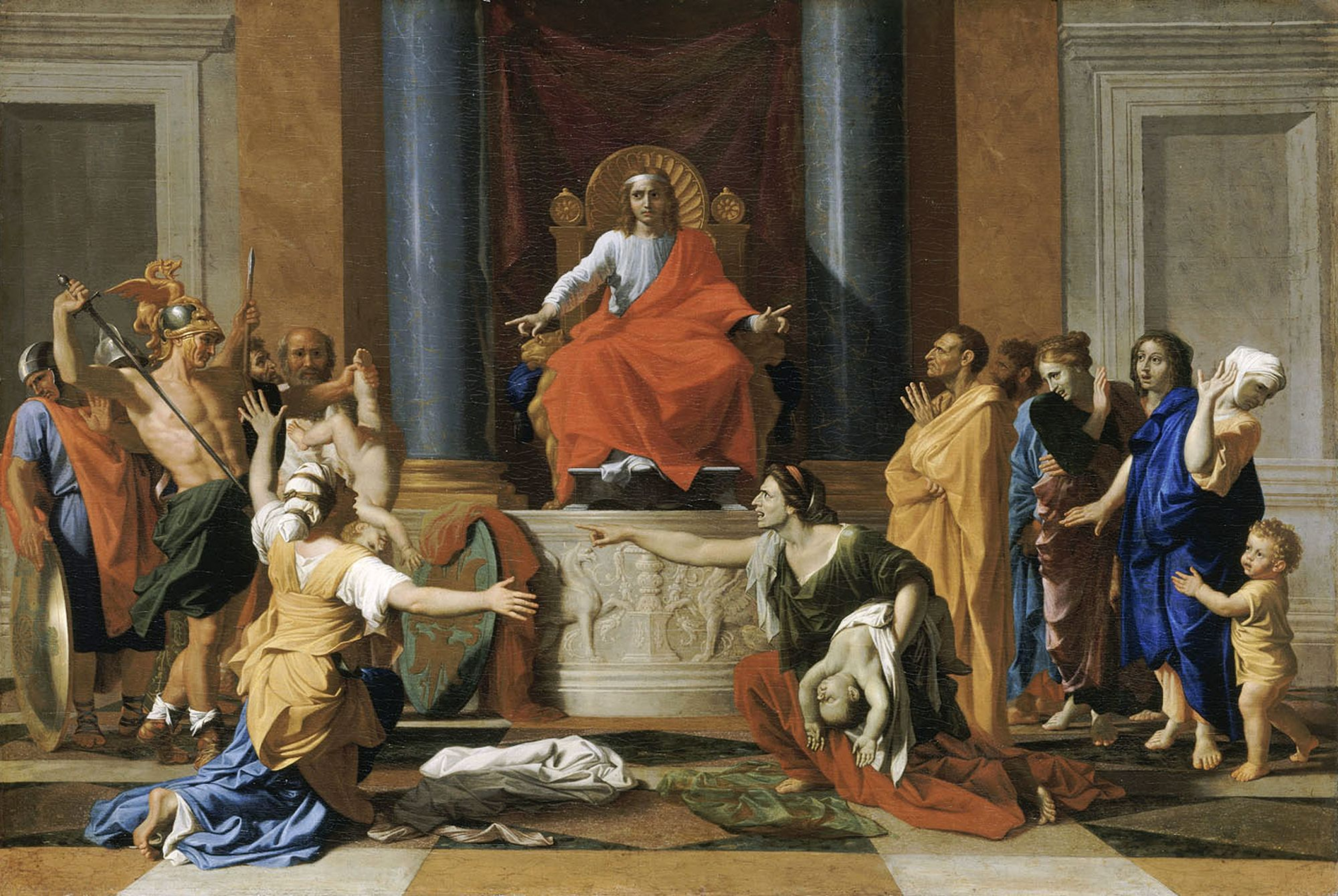

Read 1 Kings 3:1–15 before the dispute in verses 16–28. Solomon asks for an understanding heart to judge the people and discern good from bad. The following case shows judgment exercised when the women give incompatible accounts and no other person was with them in the house.
In the painting, locate the enthroned king, the raised sword, the living child held on the left and the dead child on the ground. The two foreground women and their gestures make the competing appeals visible. The attendants, clothing and architecture belong to Poussin’s presentation; they do not document the palace’s ancient appearance.
Then compare the image with the order of the text. Verse 24 introduces the sword; verse 25 orders division of the living child. In verse 26, the child’s mother asks that he be given to the other woman and not killed, while the other accepts division. Verse 27 gives the living child to the woman who sought to spare him. The threat reveals a response; the account ends with preservation of the child, not his division.
A still image makes that threatened moment striking, but it cannot supply the women’s exact speeches. Clothing colour alone cannot establish who is the mother. The decisive comparison is between the two responses in verse 26 and the verdict in verse 27. Verse 28 then reports Israel’s recognition of divine wisdom in the king’s judgment.
What Can Be Compared Without Merging the Accounts?
Psalm 138:4–6 puts kings under the Lord’s greatness and speaks of his regard for the lowly. First Kings 1–2 concerns claims to the throne, support and opposition; chapter 3 turns to a king’s request for wisdom and a dispute brought by two women. These texts give different settings in which to ask how authority is used and whose need receives attention.
They do not form a numerical explanation of 138. A concordance entry number locates an item in a reference work, while a chapter number locates a text in a particular numbering system. Neither replaces the reasons given by the psalm or the sequence narrated in Kings. A useful comparison states those reasons and preserves the differences between a succession struggle and a judgment concerning a child’s life.
Sources and Reading Limits
- Primary reading, King James Version: Psalm 138:1–8; 1 Kings 1:1–53, 2:13–25 and 3:1–28.
- Artwork identification and image status: the linked Commons record identifies Poussin’s 1649 painting and this complete reproduction. It states a public-domain basis for the artwork and the United States reproduction, with a warning that other jurisdictions may restrict reuse. Public Domain Mark records a status; it is not a new copyright license.
- The painting comparison concerns the two mothers in 1 Kings 3. Adonijah’s encounter with Solomon in 1 Kings 1:50–53 has different participants and concerns the defeated claimant’s request to be spared.
- The psalm reading does not settle the identity of the “gods,” its exact date, or the future historical manner of all kings’ praise. The narrative comparisons do not treat a threatened division as an executed sentence.
Return to reading Bible numbers in context.
Prepared by the LetsLearnTheBible.com editorial team. The image comparison follows the complete judgment episode and keeps it separate from the preceding succession account.