Rubies
The Hebrew word odem (Strong's #H124) used in Ezekiel 28:13 is translated as "ruby" in the Holy Bible Faithful Version, NASB, NCV and the NIV. It is translated either a sardius or a carnelian stone in the six other versions of Scripture used for comparison in this series. Rubies are also mentioned in other places in God's word.
And I will make your high towers of ruby, and your gates of carbuncles, and all your borders of pleasant stones (Isaiah 54:12).
Syria was your merchant because of the multitude of your works; with emeralds, purple, and embroidered work, and fine linen, and coral, and rubies they gave you for your wares (Ezekiel 27:16).
These precious gems are a reddish variety of corundum stones, while most other colors of corundum are called sapphires. These types of precious stones have a Mohs hardness value of nine, which makes them the hardest minerals known to exist (only diamonds are harder). The Smithsonian National Museum of Natural History, located in Washington, D.C., houses one of the greatest collections of this rare gem in the world.
Folklore
Anciently, it was thought that rubies, like diamonds, were created by a bolt of lightning. A popular belief was that this gemstone actually generated light from within itself.
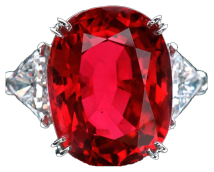
Like all reddish gemstones that resembled the color of blood, this gemstone was thought to make the wearer invincible to wounds. It also was believed to have the power to make water boil. A 13th century Cashmere physician recorded how this stone was considered a remedy not only for flatulence but also for excess bile. A well-known elixir was also made from rubies (Curious Lore of Precious Stones, pages 33, 102, 162, 168, 386).
Series References
1913 Catholic Encyclopedia
Curious Lore of Precious Stones, 1913 ed.
Diamonds, Pearls and Precious Stones, 1913 ed.
Gemstones in the Breastplate, 2008 ed.
Smithsonian National Museum of Natural History
United States Geological Survey
Gemdat.org - Mindat.org - Wikipedia
Quotes in this series taken from
Holy Bible in Its Original Order
unless noted.
Some images used in this
series are courtesy of the
Smithsonian Minerals, Gems Collection.