Rock Crystal in the Bible
Rock crystal is the colorless, transparent crystalline variety of quartz. The KJV uses the English word “crystal” five times, but these passages do not all identify that modern mineral. They include a comparison with the value of wisdom, a vision in Ezekiel, and descriptions of extraordinary clarity in Revelation.
A separate question concerns the gemstone called yahalom in the high priest’s breastplate. Some older commentary proposes rock crystal as an identification, but the Hebrew name is uncertain. The text does not establish that the stone was quartz.
What Is Rock Crystal?
The Minerals.net quartz reference describes rock crystal as colorless, transparent quartz in large crystal form. Its basic composition is silicon dioxide, SiO2, and quartz has a Mohs hardness of 7. Hardness describes resistance to scratching; it is not a measure of a stone’s symbolic importance.
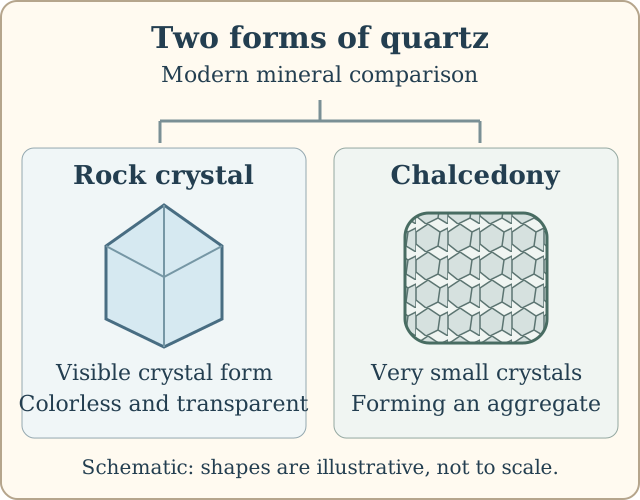
Rock crystal and chalcedony belong within the quartz family in this modern classification. Their crystal structure as visible to an observer differs: rock crystal can have a clearly visible crystal form, while chalcedony consists of an aggregate of very small crystals. Our chalcedony guide explains the latter category and its relationship to agate.
A modern mineral definition helps us describe a specimen today. Identifying a material named in an ancient text also requires linguistic and historical evidence. An English translation alone cannot provide a chemical analysis.
Where Does the KJV Mention Crystal?
In the digital KJV text counted for this guide, the complete word “crystal” occurs five times in five verses. The table includes every match. The original-language entries show why those five English occurrences should not be treated as five references to the same mineral.
| Verse | Use in context | Word-study distinction |
|---|---|---|
| Job 28:17 | Gold and crystal cannot equal the value of wisdom. | H2137, zekukith: the lexical entry includes glass or fine glass. The KJV label does not securely identify quartz. |
| Ezekiel 1:22 | The expanse above the living creatures has a crystal-like appearance. | H7140, qerach: ice or frost language. The verse describes the appearance of something in a vision. |
| Revelation 4:6 | A sea of glass before the throne is like crystal. | G2930, krystallos: crystal, with an ice-related word history. The sentence makes a comparison. |
| Revelation 21:11 | The holy city's radiance is compared with a precious stone, clear as crystal. | G2929, krystallizo: a verb describing crystalline brightness or transparency. |
| Revelation 22:1 | The river of the water of life is clear as crystal. | G2930, krystallos again. The comparison concerns the river's clarity. |
These are English-word results for one corpus. The Greek noun G2930 has two New Testament occurrences in the checked concordance, while the related verb G2929 has one. Neither number is the complete KJV English-word count. Likewise, the Hebrew breastplate name discussed below belongs to a different entry and is not an additional “crystal” match.
What Do These Crystal Passages Mean?
Job: wisdom cannot be purchased
Job 28 surveys mining, valuable materials, and the limits of human searching. Verse 17 says:
“The gold and the crystal cannot equal it” — Job 28:17, KJV, excerpt
The question is where wisdom can be found and what could purchase it. The chapter ends by associating wisdom with the fear of the Lord and understanding with departing from evil (verse 28). Whether a translator selects “crystal” or a glass-related term, the comparison places wisdom beyond the value of an expensive material. It does not instruct readers to obtain a crystal to acquire wisdom.
Ezekiel: the appearance of divine glory
Ezekiel 1:22 describes the expanse above the living creatures. The surrounding verses continue upward to a throne and culminate in a description of the appearance of the Lord’s glory (1:26–28). Repeated language of likeness and appearance matters: Ezekiel is communicating a vision through comparisons.
The Hebrew entry H7140 includes ice and frost. That helps explain the imagery of the expanse, but it does not turn the description into a claim that the structure is an ordinary piece of frozen water or a measured slab of quartz.
Revelation: clarity around God’s throne and city
Revelation 4:6 describes a sea of glass “like unto crystal” before the throne. Revelation 21:11 applies crystal-like clarity to the holy city’s radiance. Revelation 22:1 describes the river of the water of life flowing from the throne of God and the Lamb.
Across these settings, crystal language helps readers imagine brilliance and clarity. The identity of the throne, the city’s divine glory, and the river’s source provide the surrounding theological meaning. These passages give no mineral recipe, instruction for crystal healing, or promise that possessing quartz conveys the qualities described in the vision.
The gemstone list at Revelation 21:19–20 is a related but distinct passage. For a named foundation stone and the difficulty of connecting ancient and modern gemstone names, see chrysolite in the Bible.
Was Rock Crystal in the High Priest's Breastplate?
Exodus 28:18 places a stone called yahalom last in the second row of the breastplate. The KJV calls it “diamond.” The same Hebrew word occurs in Exodus 39:11, in the description of the completed breastplate, and Ezekiel 28:13, in a list of precious stones.
The checked H3095 lexical entry records three occurrences and offers uncertain identifications, including jasper, onyx, and diamond. That uncertainty should remain visible when discussing proposals such as rock crystal.
A proposal that quartz would have been easier to engrave than diamond does not establish that the actual stone was quartz. It would need further evidence connecting this Hebrew name to that material and historical setting. Exodus supplies neither a modern mineral formula nor a hardness value for yahalom. The useful answer is therefore: rock crystal is a proposed identification, not an established breastplate material.
Ezekiel 28 also needs care. Verse 12 explicitly introduces a lament over the king of Tyre. The following imagery of Eden, precious stones, and a cherub has prompted interpretations involving Satan. Such an interpretation should be identified as an interpretation; the passage should not simply be introduced as an explicit mineral inventory of a newly created Lucifer.
Common Questions
Does every biblical use of crystal mean clear quartz?
No. The five KJV verses involve different Hebrew and Greek entries, and several use a comparison. Job’s word has a glass-related lexical explanation, while Ezekiel’s belongs to ice and frost language.
Is the river in Revelation made of crystal?
Revelation 22:1 calls it a river of the water of life, “clear as crystal” in the KJV. Crystal describes the comparison; it does not replace the water with a gemstone.
Is crystal one of the twelve foundation stones?
The KJV list in Revelation 21:19–20 does not name “crystal” as a separate foundation stone. Crystal-like clarity appears earlier, in verse 11. Those descriptions should not be combined into a thirteenth entry.
Does the Bible say rock crystal has healing or divination powers?
The passages examined here do not make those claims. Stories about a material in later folklore are separate evidence about those stories, not an explanation supplied by these biblical verses or evidence of a medical effect.
Sources and Method
We checked the complete-word matches in a digital KJV text, read their surrounding contexts, and compared the word entries below. Counts ignore capitalization and refer only to that digital corpus. Modern mineral facts come from the quartz and chalcedony references, rather than from the appearance of objects in biblical visions.
- Blue Letter Bible: H2137, zekukith — the Job 28:17 glass/crystal term.
- Blue Letter Bible: H7140, qerach — ice, frost, and the Ezekiel occurrence.
- Blue Letter Bible: G2930, krystallos — the two New Testament noun occurrences.
- Blue Letter Bible: G2929, krystallizo — brightness and transparency in Revelation 21:11.
- Blue Letter Bible: H3095, yahalom — the separate, uncertain gemstone identification.
- Minerals.net: Quartz and Chalcedony — modern material categories, composition, and hardness.
Content revised October 28, 2026. Send factual corrections or source questions through our contact page.