Chalcedony in the Bible
Chalcedony is the KJV name for the third gemstone in the foundations of New Jerusalem, at Revelation 21:19. Several modern translations call the stone “agate.” In present-day mineral descriptions, chalcedony is a microcrystalline form of quartz, and agate is a banded variety within that broad category.
Those facts belong to two related discussions: interpreting an ancient gemstone name and describing a modern material. A modern chalcedony specimen can illustrate the material category. It cannot establish the exact color or mineral identity intended by an ancient author on its own.
Where Does Chalcedony Appear in the Bible?
In the KJV text checked for this guide, the complete English word “chalcedony” appears once, at Revelation 21:19. The verse describes the gemstones adorning the city’s foundations and places it between sapphire and emerald.
“the second, sapphire; the third, a chalcedony; the fourth, an emerald” — Revelation 21:19, KJV, excerpt
The Greek word is chalkedon, indexed as Strong’s G5472. The entry’s New Testament concordance has one occurrence. Its lexical descriptions concern an ancient precious stone; they should be read as historical word-study evidence rather than a gemological report on an excavated specimen.
Revelation 21:14 states that the twelve foundations bear the names of the Lamb’s twelve apostles. Verses 19–20 then list the gemstones. The text does not assign an individual apostle to the third stone or give that stone an independent set of powers.
A helpful way to read the list is to keep its order, its larger setting, and its naming questions together:
| Question | Evidence in Revelation 21 |
|---|---|
| Which place in the list? | The third stone, in verse 19. |
| What is the setting? | The foundations of the holy city's wall, described within the vision of New Jerusalem. |
| Which apostle belongs to this stone? | No individual pairing is stated. |
| What exact modern specimen is intended? | No chemical composition, hardness measurement, or source locality is supplied. |
Why Do Some Bible Versions Say “Agate”?
The versions checked for this guide use different names for the third stone. We compared the actual passage in four versions rather than assuming that a list of gemstone names is identical across translations.
| Bible version | Third stone |
|---|---|
| King James Version | Chalcedony. |
| English Standard Version | Agate. |
| New International Version | Agate. |
| New Living Translation | Agate. |
The NIV and NLT displays include notes about uncertainty in identifying some of the gemstones. The parallel passage on Bible Gateway provides the surrounding wording and notes.
In modern mineral usage, agate belongs within the broader chalcedony category. This relationship makes the names easier to compare. It does not reveal every consideration behind a translator’s choice, nor establish that John’s third stone was a particular modern banded specimen.
A photograph of a blue chalcedony cabochon therefore answers “what can modern chalcedony look like?” It does not answer “what exact shade did Revelation mean?” The two questions need different evidence.
What Is Chalcedony as a Modern Material?
The Minerals.net chalcedony guide describes it as a microcrystalline form of quartz. Its crystals are very small and form a compact aggregate. The name is also used more narrowly in the gem trade for material described as white or blue chalcedony, alongside named varieties such as agate.
| Property | Description |
|---|---|
| Material category | A microcrystalline form of quartz. |
| Basic composition | Silica, commonly represented as SiO2. |
| Hardness | Listed as 7 on the Mohs scale in the mineral guide used here. |
| Appearance | Varied colors and patterns; a waxy luster is among the appearances described. |
| Named examples | Agate is banded; carnelian is red to amber-red; chrysoprase is green. |
These names are useful for organizing modern specimens. They should not be applied backward to biblical names solely because an English word looks similar. Color, pattern, texture, and naming history all need to be considered when proposing an ancient identification.
Hardness is another limited kind of evidence. A Mohs value concerns resistance to scratching. It does not measure a stone’s spiritual meaning, identify the object in a vision, or make every material with that hardness the same mineral.
How Is Chalcedony Different from Rock Crystal?
Both are described within the quartz family in the modern mineral reference used here. Rock crystal is the colorless, transparent crystalline variety. Chalcedony consists of very small crystals forming an aggregate. That difference helps explain why a single clear crystal and a smooth piece of chalcedony can look quite different even though their basic chemistry is related.
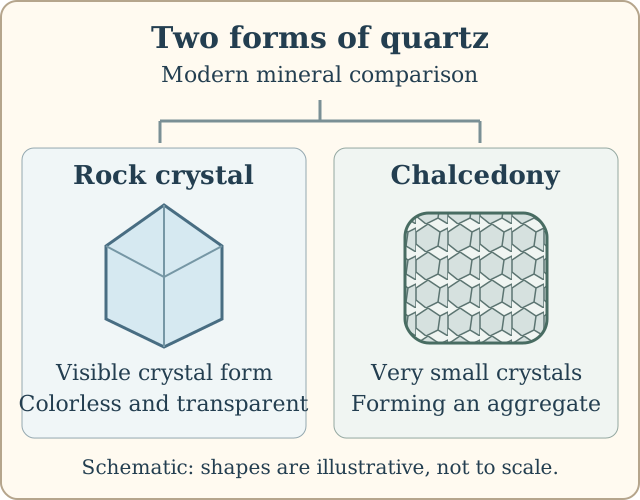
The drawing illustrates modern material categories. It is not a reconstruction of the third foundation stone. For the distinctions among quartz, biblical “crystal,” and the breastplate translation question, see rock crystal in the Bible.
What Does Chalcedony Mean in Revelation?
The third stone contributes to the vision’s depiction of a magnificent city. The larger passage associates the city with God’s glory, the Lamb, the apostles, and the presence of God among his people. Reading the gemstone within that setting preserves the author’s emphasis.
The verse does not single out chalcedony as a promise of calmness, protection, health, or success. A later devotional association may be offered as someone’s interpretation, but it should not be presented as the definition supplied by Revelation 21:19.
The surrounding comparisons are also helpful. Revelation 21:11 describes the city’s radiance with the language of a precious stone and crystal; verses 22–23 identify God and the Lamb as central to its temple and illumination. These details connect the list to the vision’s broader imagery without requiring an invented meaning for each separate mineral.
The chrysolite guide examines the seventh stone and the problem of changing gemstone names. Reading the two entries together shows why confidence about a stone’s position in the list can coexist with caution about its exact modern identification.
Common Questions
Is chalcedony always blue?
No. The modern material includes a range of colors and named varieties. White and blue are important in the narrower gem-trade use of the name. A blue specimen is an example, not a rule for the whole category or an established color for Revelation’s stone.
Are chalcedony and agate the same thing?
In the broad modern classification used here, agate is a banded variety of chalcedony. “Chalcedony” is the wider category. The KJV uses that name in Revelation 21:19, while the three modern versions checked use “agate.”
Is chalcedony named in the high priest’s breastplate?
The KJV lists in Exodus 28:17–20 and 39:10–13 do not use the English word “chalcedony.” They do include “agate.” An English label is not enough to prove that a particular ancient stone had the exact identity covered by today’s broader mineral category.
How often is chalcedony mentioned in the KJV?
The complete word occurs once in the digital KJV text counted here, at Revelation 21:19. A search for the word “agate” is a separate search and should not be silently added to that total.
Sources and Method
This guide draws on Revelation 21:9–23, the KJV breastplate lists, a checked Greek word entry, four displayed English translations, and modern quartz references. The occurrence count comes from the KJV JSON text, using complete-word matching without regard to capitalization.
- Blue Letter Bible: G5472, chalkedon — the Greek entry and its Revelation occurrence.
- Bible Gateway: Revelation 21:19–20 in four versions — the third-stone names and identification notes.
- Minerals.net: Chalcedony — modern material description, hardness, appearances, and named varieties.
- Minerals.net: Quartz — the distinction between crystalline quartz and chalcedony, including rock crystal.
Content revised October 28, 2026. For a correction or source question, contact the site owner with this page's address.