Philemon Questions: 16 Answers on Onesimus and Paul's Appeal
Read Philemon's 25 verses, then try each question before opening its answer. Some answers are direct observations; others explain the limits of a familiar reconstruction. Keep Paul's requests, conditions and hopes distinct from events the letter actually reports. The passage-by-passage Philemon outline provides a reading map and the names and reference checks.
Questions 1–4: Imprisonment, Recipients and Colosse
1. Why does Paul describe himself as a prisoner, and what do we know of the setting?
Philemon 1 and 9 call him a prisoner of Jesus Christ; verse 13 speaks of the bonds of the gospel. The letter supplies no city, arrest date or account of the legal charge. Acts 21:27–40 describes the Jerusalem disturbance and Roman intervention; 22:22–30 describes the threatened examination and Paul's appeal to his citizenship. Those narratives are useful comparisons. Identifying Philemon with the later Roman imprisonment and dating it AD 61–63 is a traditional reconstruction, not a date printed in this letter. See the setting discussion.
2. How could Paul write and send a letter while imprisoned?
The existence of the appeal and Paul's references to imprisonment show that confinement did not prevent this communication. Acts 24:23 allows acquaintances to minister to Paul in Caesarea; 28:16,30–31 describes a guard, rented accommodation and visitors in Rome. These passages show that imprisonment could include access to other people. They do not prove that every imprisonment had the same conditions, that Onesimus' meeting occurred in the Acts 28 house, or that Philemon itself authorizes exact spring AD 61–63 dates.
3. Who are Philemon, Apphia and Archippus, and where does Colosse enter the discussion?
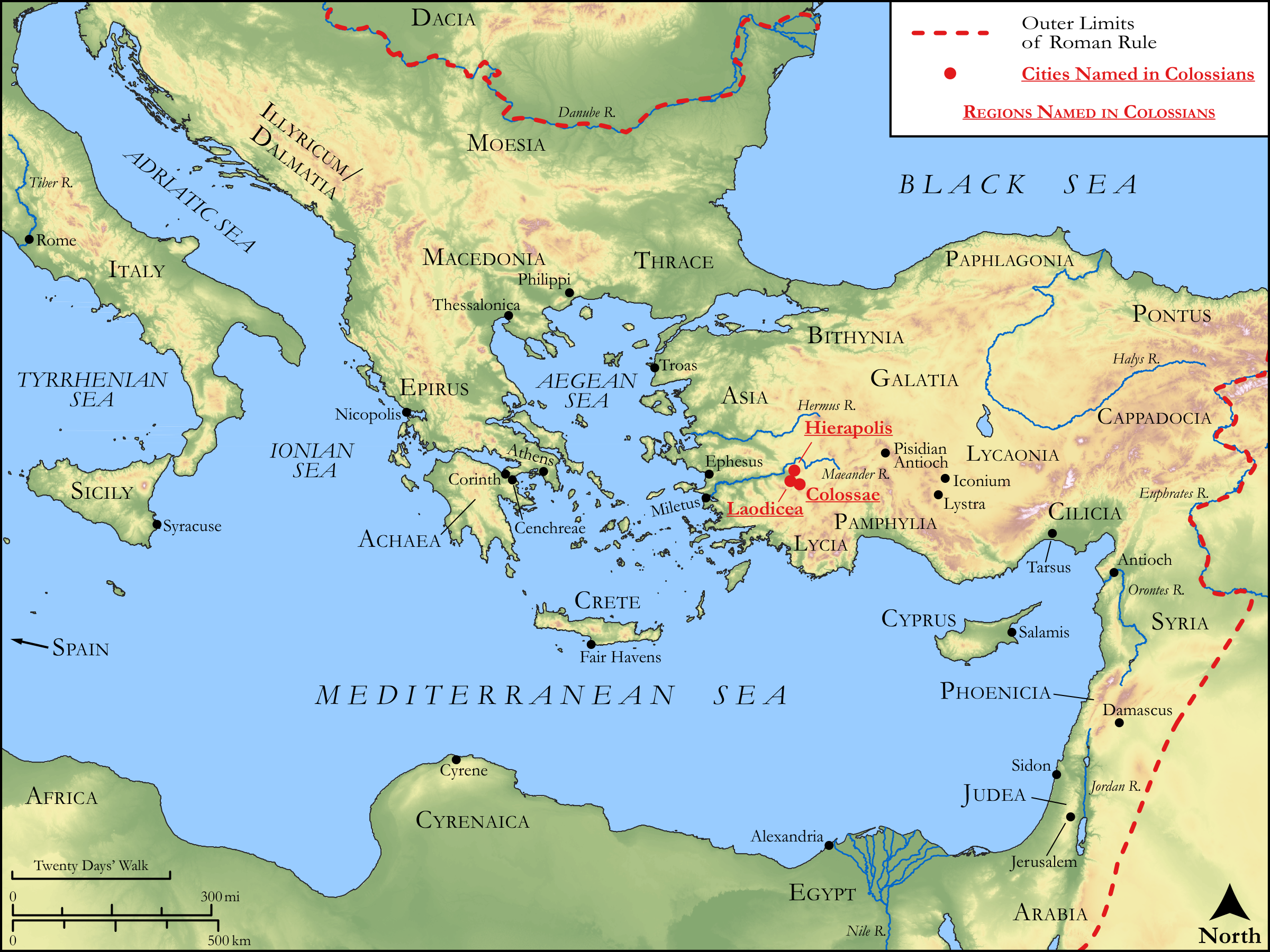
Verses 1–2 call Philemon beloved and a fellow worker, include Apphia among the beloved recipients, call Archippus a fellow soldier and greet a church in a house. The letter does not identify Apphia as a wife, Archippus as a son, the meeting day as Sabbath, or a street address. The usual Colossae association draws on Colossians 1:2; 4:9,12,17, where Onesimus and Epaphras belong to the addressed community and Archippus has a ministry. Verse 16's slave/brother contrast supplies the social setting commonly understood as Philemon's relationship with Onesimus. Use the regional map for orientation, rather than as independent proof of those family relationships.
4. Who taught the church at Colosse, and can its founder be identified from these passages?
Colossians 1:7 says the recipients learned from Epaphras and calls him a faithful minister; 4:12–13 describes his belonging to their community and his concern for Colossae, Laodicea and Hierapolis. This is substantial evidence for his formative role, which the USCCB note on Philemon 23–24 describes as founding the Colossian church. Philemon's greeting to Timothy does not itself establish Timothy as its founder. Colossians 2:1 speaks of people who had not seen Paul's face; it should not be expanded into a complete, certain itinerary for every later year of his life.
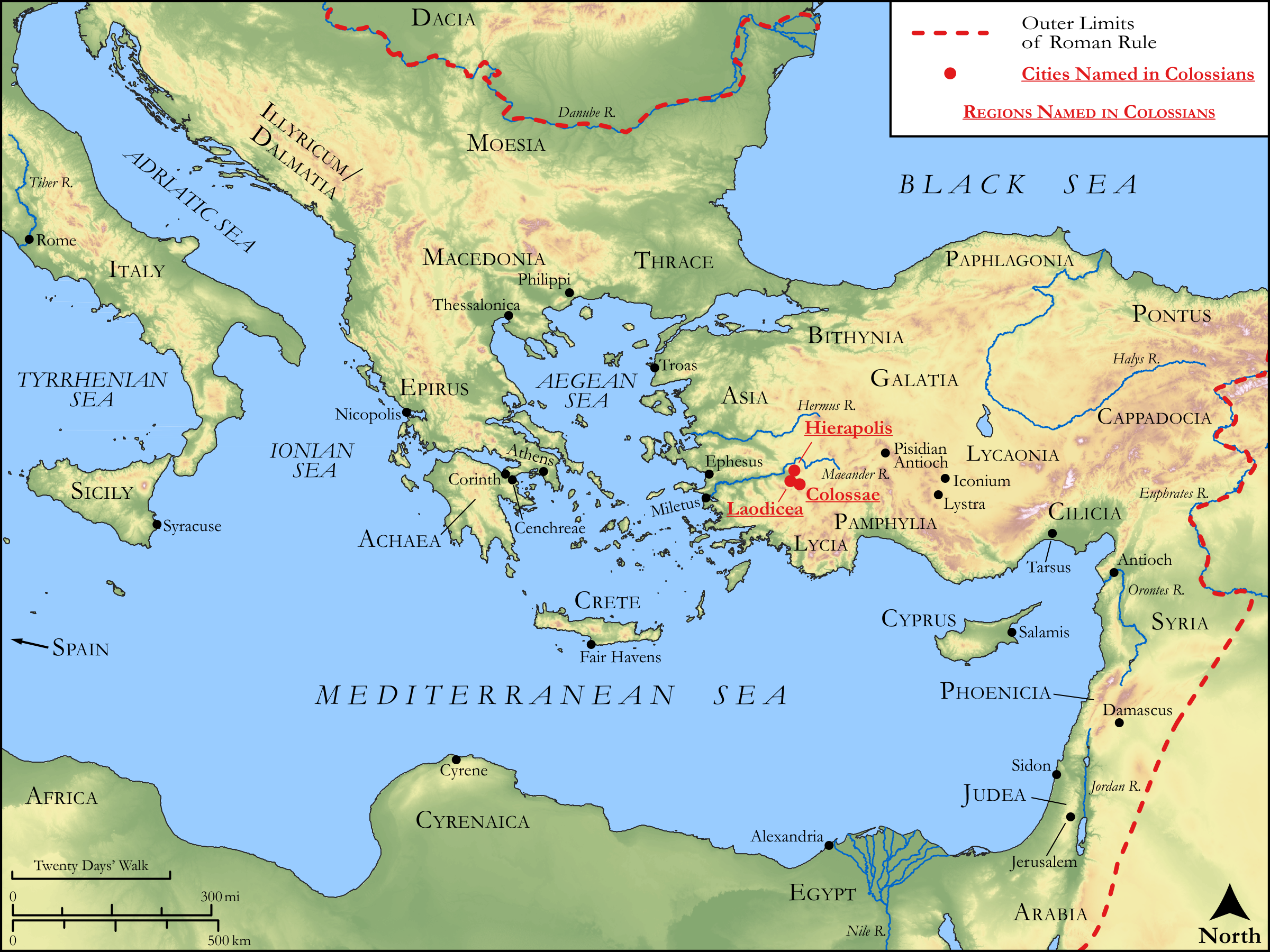
Locate Colossae, Laodicea and Hierapolis
Find the three red city labels inland from Ephesus in western Asia Minor. Colossians 1:2 and 4:12–17 give the geographical connections used in questions 3–4. The map's publisher title and legend concern Colossians; here it serves the related regional question in Philemon.
Questions 5–12: Praise, Consent and the Appeal for Onesimus
5. What do verses 5–7 contribute before Paul makes his request?
Paul acknowledges love and faith, prays for their effective expression and says the saints have been refreshed through Philemon. That established pattern of kindness prepares the appeal for Onesimus. Verse 20 returns to refreshing Paul's own inward affections. The KJV's “bowels” expresses deep affection in this setting; it is not a bodily-health report. Explaining the rhetorical role of praise does not require deciding that the thanks are insincere.
6. Why appeal through love when Paul could enjoin what is fitting?
Verses 8–9 explicitly contrast Paul's ability to enjoin with his choice to beseech for love's sake. Verse 14 develops the same concern: he will act with Philemon's consent so that the benefit is willing rather than compelled. The appeal has moral force while asking for a response made voluntarily. It should be read together with the concrete welcome in verses 16–17, rather than treated as a general withdrawal of every claim Paul makes.
7. How old was “Paul the aged” in verse 9?
The KJV describes him as aged but gives no numerical age. Calculating fifty-nine to sixty-one by assuming a birth around AD 2 and a writing date of AD 61–63 merely carries those assumptions into the result. The verse does not establish them. The USCCB note on verse 9 also distinguishes “old man” from an editorial conjecture of “ambassador,” which it says lacks manuscript support. That note is not a birth certificate or a reason to supply an exact age.
8. Who was Onesimus, and what is known about his departure and meeting with Paul?
Paul calls Onesimus his son begotten in imprisonment (10), speaks of his usefulness (11) and asks for reception above slave status as a beloved brother (16). This supports the familiar reading of an enslaved person whose relationship with Paul became spiritual kinship. The circumstances of his departure, route, intentions and first meeting are not narrated. The USCCB note interprets verse 15 as a euphemism for running away; that is an identified interpretation. Verse 18 says if he wronged Philemon or owes anything, so it should not be quoted as an explicit confession of theft.
9. What is the point of “unprofitable” and “profitable” in verse 11?
Paul says Onesimus was formerly unprofitable to Philemon and is now profitable to both of them. The USCCB note explains a wordplay on the name Onesimus, “useful” or “beneficial”; Paul later seeks a benefit or joy from Philemon in verse 20. The wordplay strengthens the appeal. It does not certify an entire history of laziness or misconduct from a name's meaning, or reduce Onesimus' value to what a master can obtain from him.
10. What does Paul decide to do, despite wishing to retain Onesimus?
In verses 12–14 Paul sends Onesimus back, expresses the wish that he could retain him to minister during imprisonment and says he will do nothing without Philemon's consent. His stated concern is that the benefit be willing. Describe that decision with the letter's own reasons before supplying a complete Roman legal procedure or assuming the response had already been settled.
11. What reception does Paul ask for, and is legal emancipation explicitly recorded?
Verses 16–17 ask that Onesimus be received above slave status as a beloved brother, “both in the flesh, and in the Lord,” and welcomed as Paul himself. That is a demanding change in relationship, not merely permission for a cold return to the previous situation. Whether it implies a request for formal emancipation is an interpretive question; the letter records neither an explicit legal emancipation formula nor the eventual decision. No fixed slave price, such as nine years of one laborer's wages, is supplied here. A financial reconstruction needs its own evidence and cannot replace these requests.
12. How does “perhaps” in verse 15 change the way Paul's suggestion should be read?
Paul suggests that a temporary separation may lead to enduring reception, then describes a beloved brother. “Perhaps” marks a possible providential interpretation. The verse does not narrate exactly why Onesimus left, prove that theft occurred, or declare that every imagined response from Philemon would resist a known divine decree. Preserve both the hopeful appeal and its tentative wording.
Questions 13–16: Debt, Lodging, a Hoped-for Visit and Delivery
13. What does Paul promise about a possible debt, and what does “mine own hand” establish?
Verses 18–19 offer to place a possible wrong or debt on Paul's account and promise repayment in his own hand. The undertaking lends personal weight to the appeal. It does not demonstrate poor writing skills or settle whether Paul penned every line without assistance. Compare Romans 16:22, where Tertius says he wrote the letter; 1 Corinthians 16:21, Colossians 4:18 and 2 Thessalonians 3:17, which identify an own-hand salutation; and Galatians 6:11. These comparisons show different uses of writing and signing language, rather than proving one unreported physical arrangement for Philemon.
14. Does verse 22 promise a visit as a reward or an inspection?
Paul asks Philemon to prepare lodging and says he hopes to be granted to the recipients through their prayers. The verse does not label the visit a reward for releasing Onesimus or announce an inspection to check obedience. A possible rhetorical effect on the recipients can be discussed as an inference, while the stated request and hope remain the starting point.
15. Does the letter report that Paul fulfilled the hoped-for visit to Philemon?
No fulfillment is narrated in Philemon. Verse 22 expresses hope; Colossians 2:1 discusses people who had not seen Paul's face, not a later travel completion. Acts 28 ends with the Roman lodging and preaching scene. Romans 15:22–29 gives plans involving Jerusalem, Rome and Spain; it does not report their eventual completion or a British mission. Combining those plans into a confident post-release route through Colossae would go beyond these passages. Keep a desired visit separate from an itinerary shown to have happened.
16. Who carried the letter, and how should the printed subscription be used?
A subscription reading “Written from Rome to Philemon, by Onesimus a servant” appears outside the letter's numbered closing blessing; it should not be quoted as verse 25 itself. The digital KJV used here ends verse 25 with grace and “Amen.” Colossians 4:7–9 says Tychicus and Onesimus will report matters to its recipients and calls Onesimus “one of you.” That supports a relevant connection between the messengers and the Colossian community. Philemon's own verses do not name the physical carrier, fix the prison city or narrate the delivery, so an exact courier assignment rests on further reconstruction or the subscription's tradition.
Sources and Next Reading
Primary reading: Philemon, KJV, in full, checked against the digital KJV corpus. Comparisons read include the Colossians passages cited above; Acts 21:27–40; 22:22–30; 24:22–27; 26:29–32; 28:16–31; Romans 15:22–29 and 16:20–24; the closing writing passages in 1 Corinthians, Galatians and 2 Thessalonians; and 2 Timothy 4:6–18.
The USCCB chapter and notes supply the explicitly attributed language, name-play and founder interpretations; NABRE wording is distinguished from the KJV. The 1913 Catholic Encyclopedia article is used as an identified example of the traditional dating reconstruction. It does not turn every proposed background detail into a statement by the letter.
Continue with the Philemon outline, its defined counts and named contacts and later-tradition comparison. To review, explain the difference between “if” (18), “perhaps” (15) and “I trust” (22) without turning any of them into a report of an outcome.