1 Peter Study Questions: 28 Questions With Passage-Based Answers
Can you show where an answer comes from, and where an interpretation begins? Read the indicated passage, try a short answer, then open the explanation. These twenty-eight questions cover the original topics while correcting claims that the letter itself does not establish. The chapter outline supplies the continuous argument and passages not individually tested here.
Readers, Hope and Holiness
1. Who are the “strangers” in 1:1, and does that word establish their ethnicity?
The addressees are scattered through five named regions and are called elect in relation to the Father, Spirit and Jesus Christ (1:1–2). Dispersion and stranger language describes their position and identity, but does not establish that all or most were ethnically Jewish. Their former ignorance, inherited way of life and former Gentile practices (1:14, 18; 4:3–4), together with 2:10's people/not-a-people contrast, support the largely Gentile audience inferred by the USCCB introduction. Jewish-scriptural language does not by itself make every recipient Jewish.
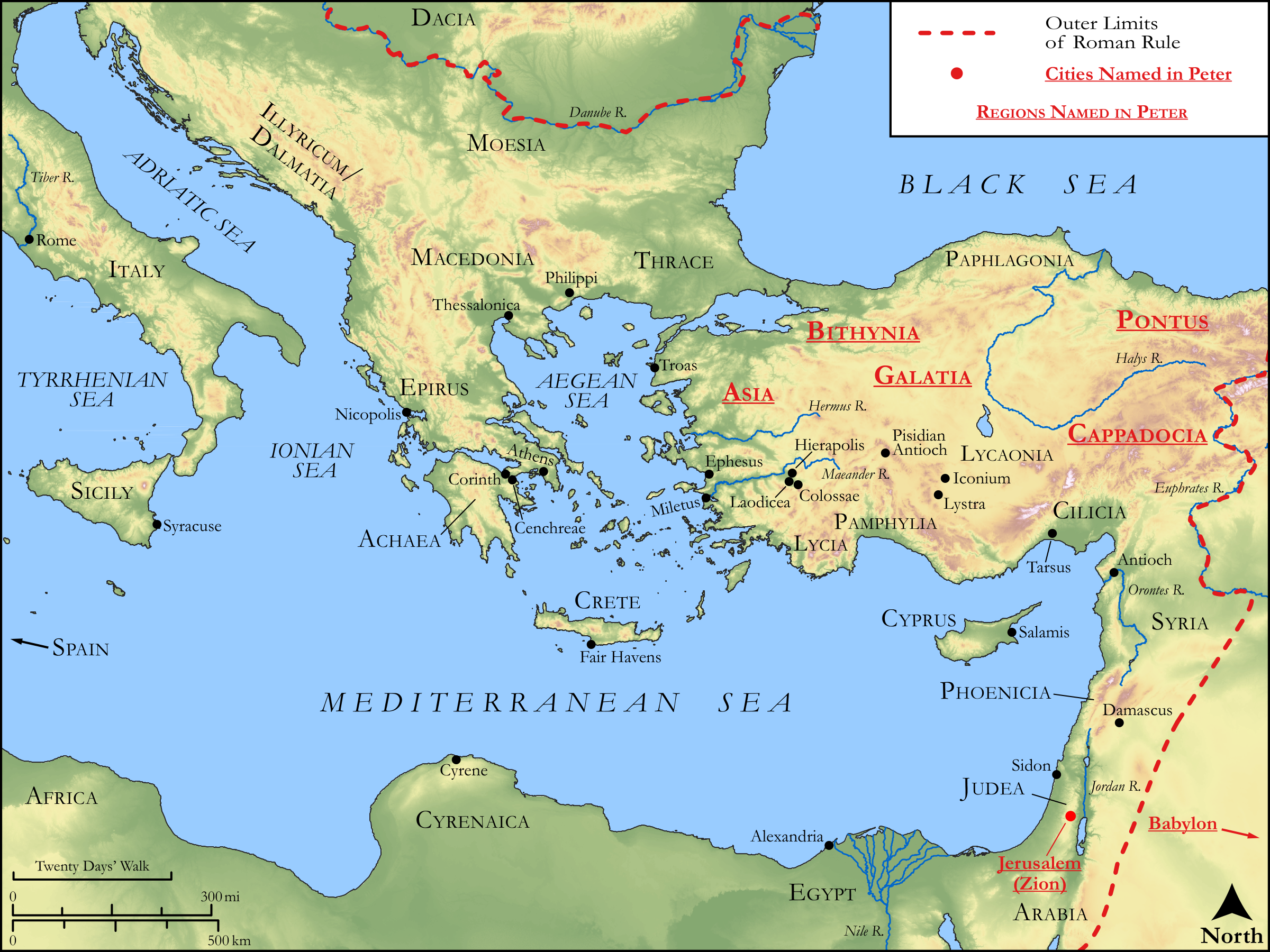
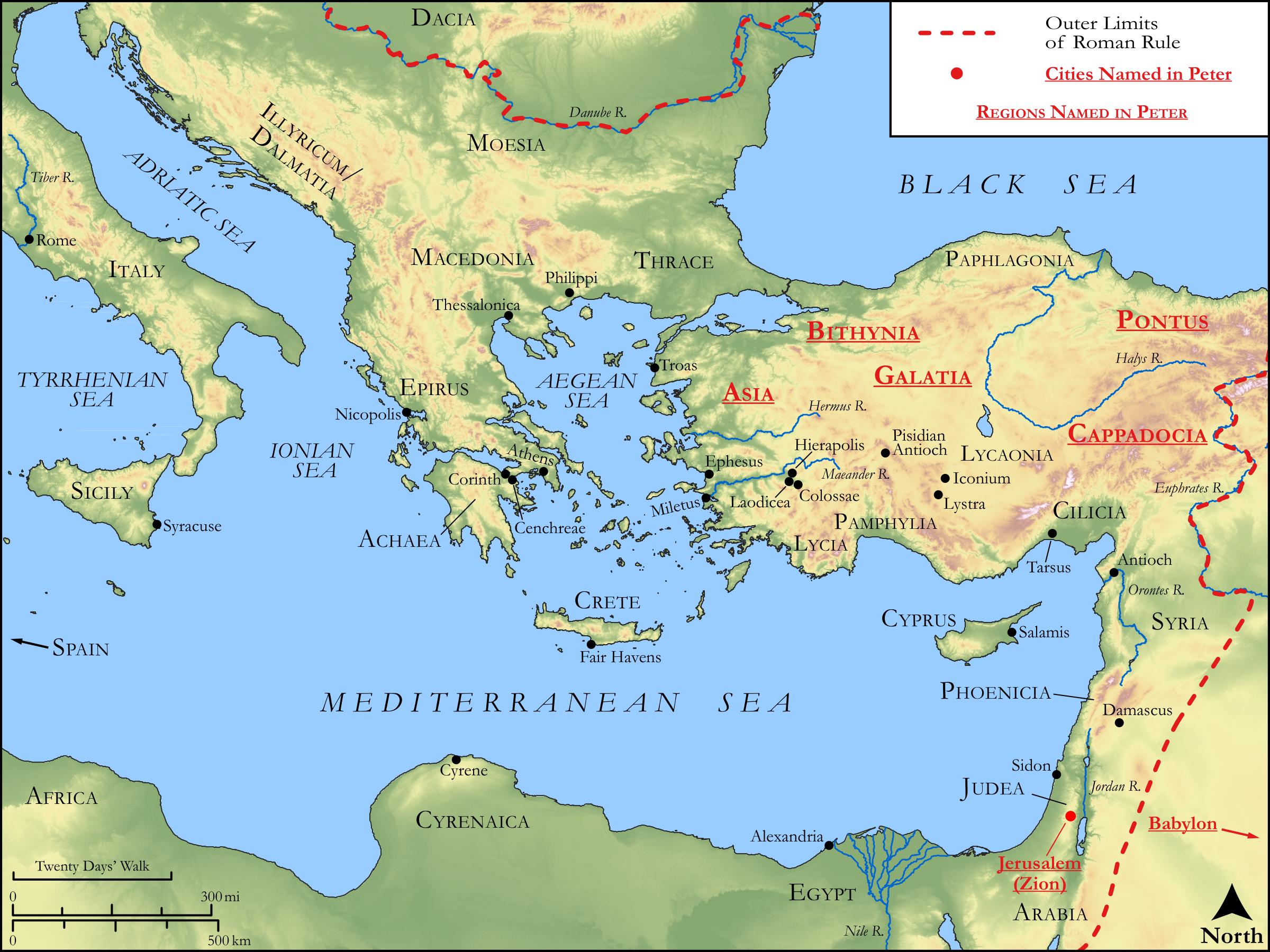
2. Locate all five regions in 1:1. Which are near the Black Sea, which is western, and which are inland?
Find the red labels on the map: Pontus and Bithynia are toward the Black Sea in northern Asia Minor; Asia is toward the Aegean coast in the west; Galatia is inland; Cappadocia is farther east. The ancient Asia name is not the entire modern continent. The five names locate the recipients broadly within present-day Turkey, rather than providing modern national or exact administrative boundaries.
3. What three descriptions of the inheritance appear in 1:3–5, and what grounds the hope?
It is incorruptible, undefiled and unfading, reserved in heaven. God's mercy and Jesus Christ's resurrection ground the “lively hope.” Believers are kept by God's power through faith for salvation ready to be revealed. The emphasis is the inheritance's security and character; these verses do not inventory the personal possessions each believer will receive.
4. What does salvation “ready to be revealed in the last time” mean in the flow of 1:3–9?
The readers already possess hope, faith and love for Christ, yet await salvation's revelation. Their present trials are set alongside joy and glory at Jesus Christ's appearing (1:7–9). This explains the forward-looking language without assigning a modern date. The paragraph does not say that salvation has no present effects, nor does it spell out every later theological distinction between present salvation and its completion.
5. Why is tested faith compared with gold in 1:6–7?
Gold is precious but perishable, and is tested by fire. Faith proved through varied trials is described as more precious, looking toward praise, honor and glory at Christ's appearing. The paragraph acknowledges real heaviness while calling the readers to hope. It does not make an abuser's acts righteous or imply that a sufferer has failed whenever they grieve.
6. What did prophets search concerning, and what do angels desire to look into (1:10–12)?
The prophets searched concerning the grace to come, the time indicated by the Spirit of Christ, and Christ's sufferings and subsequent glory. They were serving a later audience through what is now announced in the gospel. Angels desire to look into these things. Peter describes searching and disclosure, rather than claiming every prophet already possessed a complete timetable.
7. What does holiness require in 1:13–17, and where does its stated reason come from?
Prepare the mind, be sober, set hope on grace, and refuse conformity to former ignorant desires. The reason is the holiness of the one who called them: “Be ye holy; for I am holy.” Compare Leviticus 19:1–18, where holiness includes treatment of neighbors, laborers, the poor, strangers and the vulnerable. Holiness is not merely appearing religious or avoiding one disputed kind of clothing.
8. What does Christ's foreordination before the world's foundation establish in 1:18–21?
The paragraph contrasts redemption by Christ's precious blood with silver, gold and inherited empty conduct. Christ was foreordained before the world's foundation and manifested in these last times for the readers, whose faith and hope are in God. John 17:1–5 is a separate comparison concerning Christ's glory with the Father. Neither passage states that God desired Adam to sin or explains every aspect of why evil was permitted; that conclusion should not be smuggled into “foreordained.”
9. How does obeying the truth relate to love and new birth in 1:22–25?
Purification in obeying the truth is directed toward sincere brotherly love: readers are to love one another fervently from a pure heart. Peter then describes new birth through God's living, enduring word, using Isaiah 40:6–8's contrast with fading grass. James 2:14–26 supplies a useful comparison: a profession of faith that leaves a needy neighbor unaided is dead. Peter's own immediate test is not a verbal profession alone, but truthful, fervent love.
Priesthood, Stones and Public Conduct
10. Is the holy priesthood of 2:4–10 exclusively a future office?
No. Believers are described as living stones being built into a spiritual house, a holy priesthood offering spiritual sacrifices acceptable to God through Jesus Christ. Verse 9 identifies them as a chosen generation, royal priesthood, holy nation and peculiar people, with the purpose of declaring God's praises. Exodus 19:5–6 illuminates the language. Relating it to other future priesthood passages is a further theological comparison; it must not erase the present identity and service described here.
11. What passage supplies the chosen cornerstone quotation in 2:6?
Isaiah 28:16 supplies the stone laid in Zion and the assurance concerning the one who believes. Read Isaiah 28:14–22: its setting contrasts the secure foundation God lays with the rulers' refuge in falsehood. Peter applies the chosen, precious cornerstone language to Christ within his living-stone argument; he does not name Peter as that cornerstone.
12. Which two passages lie behind the rejected stone and stone of stumbling in 2:7–8?
Psalm 118:22 supplies the builders' rejected stone becoming the head of the corner. Isaiah 8:14 supplies the stone of stumbling and rock of offense. In Psalm 118:19–29 the stone belongs to praise for the LORD's saving action; Isaiah 8:11–22 warns against misplaced fear and disobedience. Peter places these together to describe Christ's differing reception. The quotations are not three unrelated construction illustrations.
13. What can observers see in 2:11–12, and does Peter date their conversion?
They can see good works despite their slander against believers. Peter speaks of their glorifying God in the day of visitation. The appeal begins with abstaining from fleshly lusts that war against the soul and maintaining honorable conduct. It does not give a dated resurrection or conversion schedule for every hostile observer.
14. What does 2:13–17 command about rulers, and how should its limits be tested?
Submit for the Lord's sake to the king and governors, do good, use freedom as God's servants rather than as a cloak for evil, honor everyone, love the brotherhood, fear God and honor the king. Compare Romans 13:1–10's governing and neighbor-love instructions. In Acts 4:18–20 and 5:27–32, Peter and the other apostles refuse orders to stop bearing witness because they must obey God. Those actual scenes help prevent treating civil submission as an unlimited command to participate in evil.
15. What difficult situation is addressed in 2:18–25, and how does Christ's example function?
Subordinate household servants are told to submit even to unjust masters; the passage explicitly mentions wrongful suffering and being beaten. It distinguishes punishment for wrongdoing from endurance while doing good. Christ suffered without sin, deceit, retaliatory insults or threats, entrusted himself to the righteous judge, and bore sins in his body so that people might live to righteousness. The closing Shepherd image and wounds language recall Isaiah 53. Applying perseverance to modern employment is an analogy, not a reason to pretend slavery was merely an inconvenient job. Nor is the text a moral license for a master or employer to injure someone.
Households, Witness and Christ
16. Does 3:1–6 simply ban women's jewelry, hair arrangements and clothing?
The passage tells wives to be subject to their husbands, including husbands who do not obey the word, with the aim that their conduct may win them. Its adornment contrast gives priority to the hidden person of the heart and a meek, quiet spirit of lasting value. Sarah is the example, and verse 6 speaks of doing well without being put in fear. A flat ban on every listed external item would include clothing itself and misses the contrast. The passage nevertheless contains real household-submission instructions; a discussion of adornment should not conceal them.
17. What obligations accompany “weaker vessel” in 3:7?
Husbands are to live with their wives according to knowledge, give them honor and recognize them as coheirs of the grace of life, so that prayers are not hindered. “Weaker vessel” is not explained as intellectual, moral or spiritual inferiority. Physical or social vulnerability is often proposed, but should be identified as an interpretation of the phrase. The explicit commands concern considerate life together and honor, and the explicit shared status is inheritance of grace. The phrase supplies no permission to dominate or harm.
18. How should believers respond to evil and insult (3:8–12)?
With compassion, brotherly love, humility and blessing rather than repayment in kind. The quotation from Psalm 34:12–16 ties a good life to restrained speech, turning from evil, doing good and pursuing peace. Compare Matthew 5:38–48 and Romans 12:9–21 for nonretaliation and love of enemies. These are concrete choices about conduct, not a promise that hostility will instantly disappear.
19. How does 3:13–17 prepare readers for suffering for doing right?
They are to resist intimidation, sanctify the Lord in their hearts, explain their hope with meekness and fear, and maintain a good conscience. Compare Isaiah 8:11–22 for the contrast between fearful conformity and reverence for the LORD. Peter says suffering for doing well, if God's will, is better than suffering for evildoing. He does not guarantee that every good action will be safe, praised or immediately vindicated.
20. What work does a good conscience do in 3:16–17?
It accompanies honorable conduct in Christ, so that the accusation of evildoing is contradicted by the believers' behavior and the slanderers may be ashamed. “I feel no guilt” is not the entire test; verse 17 explicitly distinguishes doing good from doing evil. A claim to conscience cannot turn harmful behavior into righteousness.
21. Does 3:18–21 establish a 120-year preaching visit by Christ to disobedient angels?
It says Christ suffered once for sins, was put to death in the flesh and quickened by the Spirit, and by this went and preached to the spirits in prison who were disobedient when God's longsuffering waited in Noah's days. It does not explicitly identify every spirit, describe the proclamation's content or give a 120-year visit. Genesis 6:3 mentions 120 years; Genesis 7:6 says Noah was 600 at the flood. Subtracting to obtain 480 does not establish that Christ began preaching to angels at that age of Noah. The USCCB chapter 3 notes acknowledge the uncertain identity and discuss hostile spiritual powers; another interpretation understands proclamation through Noah to people now dead. See the comparison of readings. Continue through verse 21: Peter compares baptism with the water deliverance and explicitly says “baptism doth also now save us.” His qualification follows immediately: not removing bodily dirt, but “the answer of a good conscience toward God,” through Jesus Christ's resurrection. The saving claim should be read together with that qualification, rather than omitted.
22. What does 3:22 say about Christ's position and spiritual powers?
Jesus Christ has gone into heaven and is at God's right hand, with angels, authorities and powers made subject to him. The sequence moves from suffering to resurrection, proclamation and exaltation. Ephesians 1:15–23 provides a related description of Christ's exaltation above powers. Peter does not identify a person seated at God's left hand here or describe the seating of all heavenly beings.
Changed Lives, Trials and Shepherding
23. Why are former associates surprised in 4:1–6?
Believers no longer join their former excess, drunkenness, reveling and idolatry, so the associates speak evil of them. The response looks toward accountability to the judge of the living and dead, not conformity to recover social approval. Verse 6's gospel preached “also to them that are dead” is brief and debated; it may refer to people evangelized while alive who have since died. It does not itself narrate a general postmortem conversion process. Read the paragraph's changed-life and judgment argument before importing one.
24. What does “charity shall cover the multitude of sins” mean in its communal setting (4:7–11)?
It appears alongside watchful prayer, fervent love, hospitality without grumbling and the use of gifts to serve others. Proverbs 10:12 contrasts hatred stirring strife with love covering sins; this illuminates a refusal to multiply resentments and conflict. It does not command hiding abuse or protecting an offender from truthful accountability. Leviticus 19:17–18 joins love with rebuke rather than hatred, and 1 Corinthians 13:6 says love rejoices in truth, not wrongdoing.
25. Does the “fiery trial” identify Rome's fire and a precisely dated persecution (4:12–19)?
No fire date or emperor is named. Peter tells readers not to be surprised by suffering, connects sharing Christ's sufferings with future joy, and distinguishes suffering as a Christian from suffering for murder, theft, evildoing or meddling. Judgment begins at God's house; those suffering according to God's will should entrust themselves to the faithful Creator while doing good. The USCCB introduction discusses local harassment and competing dating proposals. The imagery alone cannot establish the old account's fixed AD 64 setting, a percentage of Rome destroyed or a uniform empire-wide prosecution.
26. What must elders do, and what must they avoid (5:1–4)?
Feed God's flock and take oversight willingly and eagerly, avoiding compulsion, greed and lording it over those entrusted to them; become examples while awaiting the chief Shepherd. Peter calls himself a fellow elder. This is not merely a direction to all older males with no recognized responsibility: compare appointed elders in Acts 14:23, the elders/overseers of Acts 20:17–35 and the qualifications in Titus 1:5–9. Rejection of domination tests leadership's behavior without, by itself, settling every later choice of church organization. See shared service and accountable oversight.
27. Why is the devil compared with a roaring lion (5:5–11)?
The image stresses a dangerous adversary seeking someone to devour, calling for sobriety, vigilance and steadfast resistance in faith. Readers are reminded that fellow believers also suffer and that God's grace will establish them. The preceding instructions add humility and casting anxiety on God because he cares. The lion is a comparison, not a description of Satan's bodily form, and vigilance is not a command to live in unending panic.
28. Does “Babylon” in 5:13 conclusively identify where Peter wrote?
The greeting names Babylon, the one elected with the recipients and Mark, called Peter's son; Silvanus appears in 5:12. The name may be understood literally as Mesopotamian Babylon or figuratively as Rome. The USCCB introduction presents Rome as the traditional setting. A later date for Revelation does not logically rule out a symbolic use in this letter. The map in question 2 locates the Mesopotamian name but cannot determine this literary question. Compare the Babylon guide for the distinction between a place label and its possible use in the greeting.
Sources and Further Study
Primary reading: all five chapters of 1 Peter, KJV, checked in the digital KJV corpus. The USCCB introduction and chapter 3 notes provide the attributed scholarly and interpretive comparisons; their translation wording is not silently substituted for the KJV.
Use the chapter outline to connect the answers to the continuous argument. Its source list identifies the contexts behind the Old Testament quotations and cross-book comparisons used here. For a narrower exercise on one difficult passage, compare spirits in prison; for a theme across books, see love passages.