Psalm 143, a Misread Census and Jacob and Rachel at the Well
Psalm 143 is a prayer for mercy, rescue and guidance; Psalm 119:143 describes delight in God’s commandments during anguish. These references locate passages rather than count people or assign a shared symbolic meaning to 143. A census sometimes connected with this number needs a separate correction: Ezra 2:25 actually records 743, with the word “seven” included in the number.
What Does Psalm 143 Ask For?
Psalm 143 begins by asking God to answer in faithfulness and righteousness. The speaker immediately adds, “enter not into judgment with thy servant,” because no living person can be justified in God’s sight (verses 1–2, KJV). The prayer therefore appeals to God’s character while admitting the servant’s own need for mercy.
The rest of the psalm moves through distress, remembrance and requests for help. Reading the final verse with the opening prevents the prayer from becoming either a cheerful slogan or merely an appeal against enemies.
| Verses | What the prayer says | What to notice |
|---|---|---|
| 1–2 | Hear and answer; do not enter into judgment with your servant. | The appeal begins with God's faithfulness and the servant's need for mercy. |
| 3–4 | An enemy has crushed the speaker, whose spirit and heart are overwhelmed. | The distress is stated plainly rather than treated as a failure to feel confident. |
| 5–6 | The speaker remembers God's works, stretches out hands and thirsts for God. | Remembering earlier works leads to a present appeal for God. |
| 7–10 | Answer quickly, show lovingkindness, reveal the way, deliver and teach. | The speaker asks both to escape danger and to learn God's will. |
| 11–12 | Preserve life, bring the servant out of trouble and destroy the enemies. | The severe closing appeal remains part of the poem; its last words identify the speaker as God's servant. |
Verse 10 makes guidance central: “Teach me to do thy will; for thou art my God.” The requested rescue is accompanied by a desire to be led by God’s good spirit. Verse 12 also asks for enemies to be cut off and destroyed. A reading that keeps only the reassuring lines would miss this difficult ending. It is an appeal addressed to God within the prayer, rather than an instruction here for readers to attack their opponents.
For personal study, trace the requests in verses 7–12 and ask how “teach me” changes a prayer focused only on getting out of trouble. The chapter’s message comes from these requests and their setting; its label, 143, supplies the reference.
Why Read Psalm 119:143 with Verses 137–144?
Psalm 119:143 says, “Trouble and anguish have taken hold on me: yet thy commandments are my delights” (KJV). The verse holds anguish and delight together. It does not say that delight removes the trouble immediately.
The surrounding eight verses develop that thought. Verses 137–138 praise God’s righteous judgments and faithful testimonies. Verses 139–141 describe opponents who forget God’s words and a speaker who is small and despised but continues to remember God’s precepts. Verses 142–144 return to enduring righteousness, truth and a request for understanding and life.
Compare the two prayers: Psalm 143:10 asks to be taught God’s will; Psalm 119:144 asks for understanding. Both connect distress with a desire for direction. This is a comparison of what the passages say, not evidence that a matching chapter or verse label creates a hidden numerical connection.
Ezra 2:25 Counts 743, Not 143
The complete KJV wording is: “The children of Kirjath-arim, Chephirah, and Beeroth, seven hundred and forty and three.” The number is 743. Searching only for the ending “hundred and forty and three” can overlook the word that determines which hundred is being counted.
Nehemiah 7:29 records the corresponding group as “seven hundred forty and three.” The small difference in English wording does not change the quantity. Both entries group the named places together; neither assigns 743 to each place individually.
| Passage | People identified in the KJV | Complete quantity |
|---|---|---|
| Ezra 2:25 | The children of Kirjath-arim, Chephirah and Beeroth | 743 |
| Nehemiah 7:29 | The men of Kirjath-jearim, Chephirah and Beeroth | 743 |
Ezra 2:1–2 introduces people returning from captivity. Nehemiah 7:5–7 explains the finding of a register of those who had returned with Zerubbabel. This context identifies the numbers as roster entries. The agreement of this particular pair should not be used to claim that every figure in the two chapters is identical: for example, Ezra 2:28 records 223 for Beth-el and Ai, while Nehemiah 7:32 records 123.
Jacob and Rachel at the Well: Text and Painting
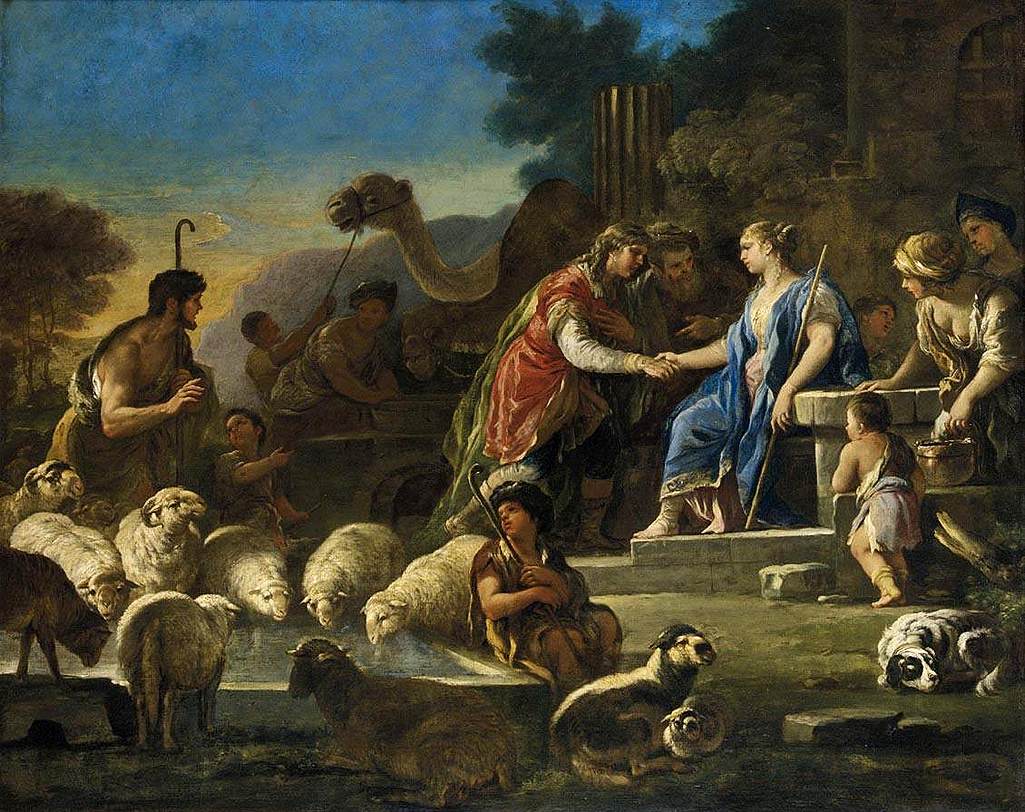
Luca Giordano’s Jacob and Rachel at the Well, dated circa 1690, offers a different reading exercise: compare an artist’s presentation with Genesis 29:1–12. The complete composition shows a pastoral encounter, with sheep across the foreground and a seated woman in a blue cloak holding a shepherd’s staff. The central pair join hands beside the well.

| Detail to examine | Genesis 29:1–12 | What the painting adds or emphasizes |
|---|---|---|
| The flocks | Shepherds gather at a well; Rachel arrives with her father's sheep because she keeps them. | The full scene surrounds the meeting with sheep and figures, making its pastoral setting easy to see. |
| The meeting | Jacob waters Laban's flock, kisses Rachel, weeps and explains their kinship. | The central handclasp presents a greeting; it should not replace the actions and words described in the text. |
| The setting and clothing | The passage describes the well and its covering stone without specifying the figures' dress or this architectural arrangement. | The blue cloak, staff, surrounding architecture and arrangement of onlookers belong to the artist's presentation. |
The sheep and Rachel’s staff help explain why the picture is identified as this encounter. They do not verify a likeness of Rachel or establish a word count. Compare the entire image with the passage before treating any painted detail as part of the biblical narrative.
What Happens Later to Leah and Rachel?
The meeting at the well precedes the marriages and household conflict. Genesis 29:15–30 recounts Jacob’s service for Rachel, Laban’s substitution of Leah and Jacob’s marriage to Rachel as well. Verse 30 states that Jacob loved Rachel more than Leah. Verses 31–35 then turn to Leah’s distress and the births of Reuben, Simeon, Levi and Judah.
Genesis 30 continues the rivalry, including Bilhah and Zilpah and the account of the mandrakes. In verses 22–24 God remembers and hears Rachel, opens her womb and she gives birth to Joseph. Reading this sequence prevents the painting of the first meeting from being mistaken for a depiction of Joseph’s birth or the later household events.
These are particular accounts of the people in the narrative. They do not promise that seeing or using 143 will bring a pregnancy, or make a person’s childlessness evidence of divine disfavor. A claimed total for a Hebrew word would need its own specified text and counting method; it would not turn these events into a promise attached to that total.
Sources and Further Reading
The biblical reading for this guide uses the King James Version: Psalm 143; Psalm 119:137–144; Ezra 2 and Nehemiah 7; and Genesis 29–30. The census comparison concerns the entries identified above, rather than a claim about every occurrence of a number throughout the Bible.
For the painting’s title, date and attribution, see the Web Gallery of Art record and the file-specific Commons record linked in the caption. The painting is an aid to comparing a later visual interpretation with Genesis, not a source for numerical symbolism.
For a broader approach to ages, quantities, references and proposed occurrence totals, read how to read biblical number studies.