Psalm 129, Paul's Two Names and the History of Persecution
Psalm 129 remembers Israel’s affliction and appeals to the righteous Lord against those who hate Zion. It offers a substantial passage to study when looking up 129. Other associations require different kinds of reading: Acts 13:9 introduces the name Paul, Strong’s G129 identifies a Greek word for blood, and an older history reference estimates about 129 years of Roman persecution. These are a passage reference, a dictionary entry and a historical calculation; they do not supply a single meaning shared by the number.
Psalm 129: Affliction, Survival and a Difficult Prayer
The opening invites a community to speak: “Many a time have they afflicted me from my youth, may Israel now say” (verse 1, KJV). The repeated line in verse 2 adds the decisive qualification: “yet they have not prevailed against me.” Israel’s survival does not erase the suffering described in the next verse. The image of plowers making long furrows across a back makes the violence painfully concrete.
Verse 4 turns from the oppressors to the Lord: “The LORD is righteous: he hath cut asunder the cords of the wicked.” The poem grounds deliverance in God’s righteousness. It does not give a length of time for the affliction, identify a particular emperor or name a date when every threat will cease.
| Verses | What happens in the poem | A question for close reading |
|---|---|---|
| 1–2 | Israel repeats its history of affliction, while declaring that its enemies have not prevailed. | How does the second statement change the first without denying it? |
| 3–4 | The wounded back is compared to a plowed field; the righteous Lord cuts the wicked's cords. | Who acts to break the oppressors' power? |
| 5–6 | The prayer asks that those who hate Zion turn back in shame and become like grass withering on rooftops. | How does the second agricultural image contrast with the long furrows? |
| 7–8 | The grass produces no handful for a mower or sheaf for a binder, and passersby offer no harvest blessing. | What does this ending ask to be withheld from the enemies? |
The ending is severe. It asks for the enemies’ efforts to wither rather than flourish, and it withholds the picture of a blessed harvest. Reading only “they have not prevailed” would miss half the psalm. The poem combines a memory of survival with a prayer against continuing hostility. Its requests are addressed to God; the text does not here instruct the reader to inflict the pictured injuries on another person.
A useful study exercise is to mark the change at verse 5. Verses 1–4 look back on affliction and deliverance; verses 5–8 voice a wish concerning Zion’s enemies. Keep both movements in view before applying the psalm to a present difficulty. Its chapter number locates the prayer rather than prescribing 129 days or years of suffering.
Acts 13:9 Gives Two Names, Not a Renaming Ceremony
Acts 13:9 reads, “Then Saul, (who also is called Paul,) filled with the Holy Ghost, set his eyes on him” (KJV). The parenthesis tells readers that Saul is also called Paul. It does not say that God changes his name at this point, or that Saul receives Paul as a reward for a miracle.
Read the incident within Acts 13:1–12. Barnabas and Saul are set apart at Antioch and sent out. On Cyprus they meet Sergius Paulus, who wants to hear the word of God. Elymas opposes them and seeks to turn the official away from faith. Paul confronts him, announces temporary blindness, and the narrated event follows. Verse 12 records Sergius Paulus’s belief and astonishment at the Lord’s teaching.
The rest of the chapter broadens the story. Verses 13–41 follow the journey to Pisidian Antioch and Paul’s speech about Israel’s history, Jesus’ resurrection and forgiveness. Verses 42–52 describe further interest, opposition, the appeal to the Gentiles, expulsion and the disciples’ joy. The chapter helps readers follow the mission through both welcome and persecution. Neither verse 9 nor the chapter supplies a calendar year for the encounter with Elymas.
Colossians 1:29 offers another passage sometimes connected with the digits 129. In verses 24–29, Paul describes service to the church, the revealed mystery, and the work of proclaiming and teaching Christ. His labour in verse 29 depends on God’s working in him. The reference 1:29 identifies chapter and verse; joining its digits does not make the passage a statement about the quantity 129.
Strong's G129: Let the Sentence Explain “Blood”
Strong’s Greek entry G129 identifies haima, “blood.” A dictionary number makes a word easier to find. To understand a particular use, read the expression and its surrounding passage.
In Matthew 16:13–20, Jesus asks who people say he is, then asks his disciples directly. Peter confesses him as the Christ, the Son of the living God. Jesus replies that “flesh and blood” has not revealed this to Peter, but his Father in heaven has (verse 17). Here the expression concerns human agency in contrast with revelation from the Father. It is not a statement about an animal sacrifice or a wounded body.
Revelation 19:1–10 supplies a different setting. The heavenly praise in verse 2 speaks of God avenging the blood of his servants in judging the corrupting figure called the great whore in the KJV. The passage continues with worship, the marriage of the Lamb and the instruction to worship God. In verse 2, blood concerns the violence done to God’s servants. The same dictionary entry can help locate both examples without making their immediate meanings identical.
This comparison is more useful than assigning a spiritual message to the index number. An occurrence total would require a specified Greek text and counting method; no total is needed to follow either passage here.
H129 Is Adami; “Edomites” Belongs to H130
The Hebrew and Greek Strong’s lists have separate numbering. H129 identifies Adami, a place name in Joshua 19:33, within the boundary description for Naphtali in verses 32–39. The KJV prints “Adami, Nekeb”; the lexicon also records the combined form Adami-nekeb.
This entry should not be combined with “Edomites” in 1 Kings 11:17. That word is listed under H130. In 1 Kings 11:14–22, Hadad is an Edomite who escaped to Egypt as a child; the passage recounts his reception there and later request to return to his country. It is a narrative about people and political opposition, whereas Joshua’s entry is a geographical boundary marker. Similar-looking transliterations do not make the two dictionary entries interchangeable.
The Bethlehem Journey and a Sabbatical Calendar
Luke 2:1–20 tells of the registration under Augustus, Joseph’s journey from Nazareth to Bethlehem with Mary, Jesus’ birth and the shepherds’ visit. Verse 4 explicitly connects Joseph with David’s house and lineage. The passage names the departure and destination, but gives no mileage, exact route or travel duration.
An estimate of 80 miles converts to about 129 kilometres. That arithmetic explains how 129 can enter a modern retelling; it does not establish that 80 miles was the distance Joseph and Mary travelled. Luke’s account itself provides no 129-kilometre measurement, and it does not give the birth year as 5 BC. A precise journey reconstruction or historical dating argument needs evidence beyond this passage.
Likewise, Leviticus 25:1–7 commands six years of cultivation followed by a seventh year of rest for the land. Deuteronomy 31:9–13 associates the year of release with a public reading of the law at the Feast of Tabernacles. These passages explain the observance and its teaching purpose. They do not identify the modern calendar dates of a sabbatical year ending in 129 BC. Such dates depend on a separately argued chronological reconstruction.
Was There a Biblical Period of 129 Years of Persecution?
The often-repeated figure comes from a later reference work. The Catholic Encyclopedia article “Martyr,” under “Number of the martyrs,” estimates that Christians experienced persecution for about 129 of the 249 years between Nero’s persecution in AD 64 and AD 313. It describes the other years as involving a degree of toleration, while immediately warning that even comparative tranquillity did not remove danger from hostile individuals.
The word “about” matters. This is an author’s historical estimate across an extended period, not a date range stated in the Bible or a claim that every Christian in every province suffered continuously for an identical interval. The same section says that no definite number of those killed can be given, and notes that the last persecution ended earlier in the West than in the East. A total of years cannot tell the whole story of different communities’ experiences.
The translated toleration documents of AD 311 and 313 also make the transition more specific than a story about one emperor ending every danger at once. Galerius’s document permits Christians to exist and meet, subject to public order. The later text names Constantine and Licinius, grants freedom of religious observance to Christians and others, and orders the return of Christian communal property. Reading both documents distinguishes permission to worship from the restoration of property and acknowledges the earlier measure.
The toleration documents concern Roman history later than the New Testament narratives. They can illuminate the history of Christian persecution, but they do not establish that Psalm 129 predicts that chronology.
What Can Bernini's Constantine Help Us See?
Bernini’s later sculpture of Constantine at the Scala Regia provides a visual exercise in separating commemoration from historical evidence. In Sailko’s photograph, the rider looks upward while the horse rears; enormous drapery, the arch and the surrounding columns frame the figure. The complete photograph preserves the architectural setting as well as the sculpture.
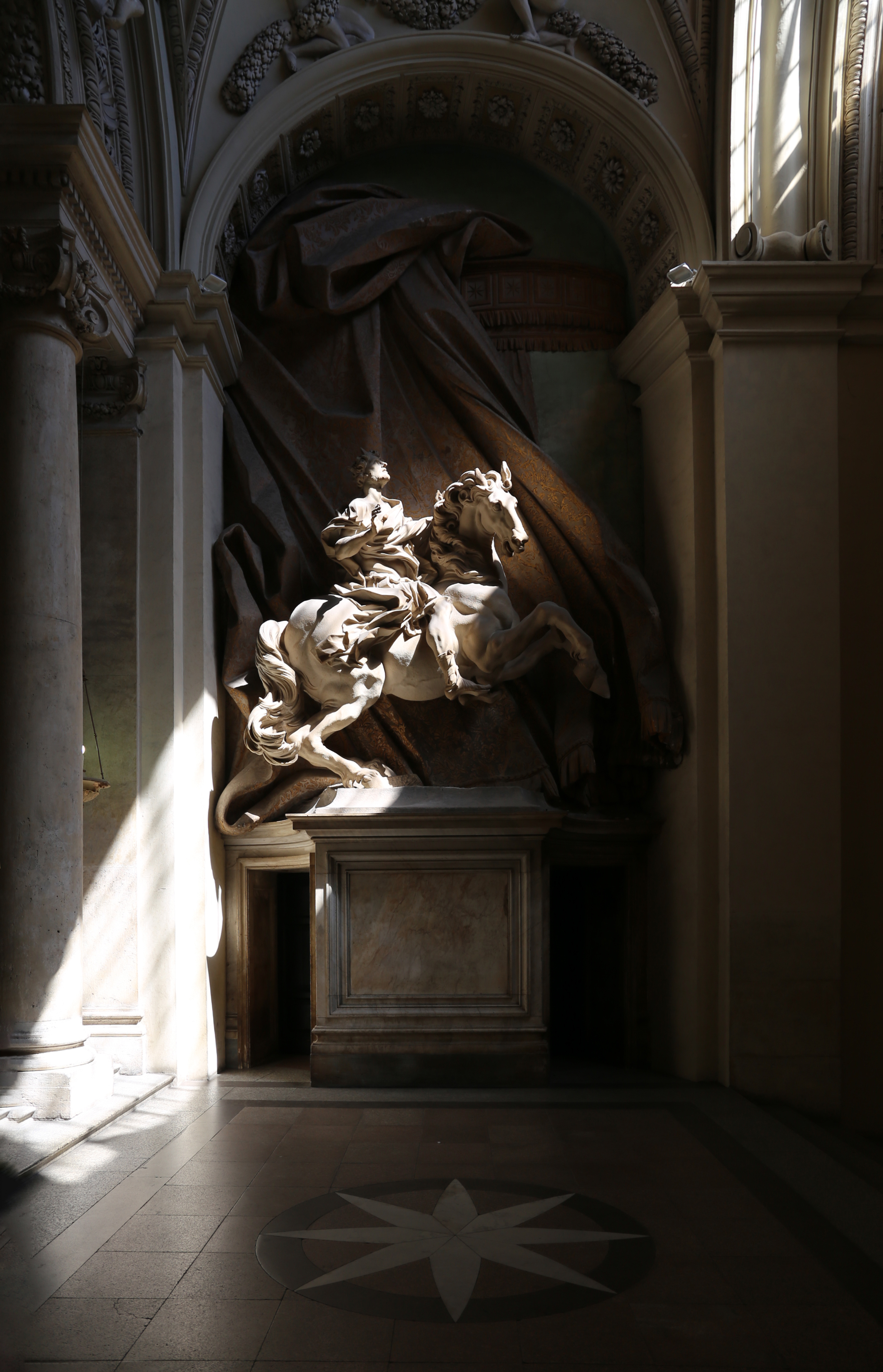

Look first at what is visible: the lifted head, the horse’s movement, the light on the figures and the dark folds behind them. Then compare the image with the toleration documents. The sculpture makes a dramatic presentation of an emperor; the documents address worship, public order and property. The image cannot verify the encyclopedia’s 129-year estimate, show the signing of the AD 313 measure or establish what Constantine looked like from personal observation.
Keeping these sources in their proper roles allows each to contribute something different: Psalm 129 voices affliction and an appeal for justice, Acts narrates the mission, the historical documents record official provisions, and the sculpture shows a later artistic presentation of Constantine.
Sources and Further Reading
Biblical passages are read here in the King James Version: Psalm 129; Acts 13; Colossians 1:24–29; Matthew 16:13–20 and Revelation 19:1–10; Joshua 19:32–39 and 1 Kings 11:14–22; Luke 2:1–20; and Leviticus 25:1–7 and Deuteronomy 31:9–13.
The linked Strong’s entries support the word identifications above; their dictionary numbers are kept separate from quantities in a biblical narrative. The Catholic Encyclopedia supplies the qualified historical estimate. Fordham University’s Internet History Sourcebooks Project presents English translations of the AD 311 and 313 documents preserved in Lactantius, On the Deaths of the Persecutors, chapters 34–35 and 48. The photograph’s own Commons record and license are linked in its caption.
For the difference between quantities, passage references and proposed numerical patterns, see how to read biblical number studies.