Psalm 128: Work, Household and Peace for Israel
Psalm 128 connects reverence for the Lord with work, a flourishing household, the good of Jerusalem and peace upon Israel. Its six verses move outward from the person who fears the Lord to the table, later generations and the wider community. A separate Hezekiah comparison helps distinguish a biblical account, a genealogy and a later artist’s depiction of a family.
What Holds the Household and the City Together?
The opening does not begin with a word count. It calls blessed the person who fears the Lord and walks in his ways. Work and family images follow that statement; the closing invokes blessing from Zion and peace upon Israel.
| Verses | Image or statement | Connection |
|---|---|---|
| 1–2 | Fear the Lord, walk in his ways and eat the labor of one's hands. | Blessing is introduced alongside conduct and the fruit of work. |
| 3–4 | A fruitful vine and olive plants picture wife and children around the table. | The household develops the blessing imagery. |
| 5 | Blessing comes out of Zion, with the good of Jerusalem in view. | The horizon extends beyond one household. |
| 6 | Children's children and peace upon Israel close the poem. | Later generations and communal peace belong to the ending. |
Verse 4 deliberately returns to the person who fears the Lord. That repetition joins the family image to the opening, while verses 5–6 keep the poem from ending as a private account of material success.
Do the Vine and Olive Plants Guarantee Every Family Outcome?
The vine and olive plants are comparisons for flourishing life around the house and table. The poem addresses a man with a wife and children in its pictured household. It does not give a medical explanation of infertility or a test by which the worth of an unmarried, widowed or childless person can be measured.
Reading a blessing as an accusation against someone whose circumstances differ would add a conclusion the poem does not state. The imagery can be appreciated as an expression of hoped-for household good without claiming that every faithful person must have an identical family size or an uninterrupted prosperity.
Verse 2 also names eating the labor of one’s hands. It is not a promise that a particular investment, wage or business will succeed because its figures contain 128. Its language belongs to the poem’s picture of life ordered in reverence for the Lord.
Why Does the Ending Mention Jerusalem and Israel?
The blessing in verse 5 comes “out of Zion,” and the good of Jerusalem is to be seen throughout the person’s life. Verse 6 joins children’s children with peace upon Israel. A reading that keeps only the wife-and-children comparison misses those wider concerns.
The ending can therefore be read as a blessing that encompasses a household within a community. The text does not require the reader to calculate a date from 128 to discover when peace will arrive.
A Biblical King Is More Than a Proposed Name Total
The Hezekiah accounts supply actual identifying details. Second Kings 18:1–2 names him as the son of Ahaz, identifies his mother as Abi, daughter of Zachariah, and states that he began to reign at twenty-five and reigned twenty-nine years. The following verses describe his conduct, reforms and trust in the Lord. These details can be read without a claim about how many times his English name occurs.
Second Kings 19 narrates a crisis with Assyria, Hezekiah’s appeal and prayer, Isaiah’s response and the outcome described by the account. Second Kings 20 adds illness, prayer, a promised extension of life, recovery and the visit of Babylonian envoys. It also narrates Isaiah’s warning after Hezekiah shows the visitors his treasures. A description that presents him only as a successful or idealized ruler would omit that later episode.
| Source | What it supplies | What it does not supply |
|---|---|---|
| 2 Kings 18:1–8 | Parentage, accession age, reign length and an assessment of conduct. | A portrait of his childhood with both parents. |
| 2 Kings 19–20 | Prayer, danger, illness, recovery, envoys and a warning. | A rule that every faithful household will experience the same events. |
| Matthew 1:1–17 | A genealogy in which the KJV names “Achaz,” “Ezekias” and “Manasses” in sequence. | Stage directions for a domestic scene or the appearance of each person. |
These passages do not identify Hezekiah’s family as the household pictured in Psalm 128. They are a separate comparison of how a person can be identified and interpreted from different kinds of sources.
What Can an Ancestor Fresco Show?
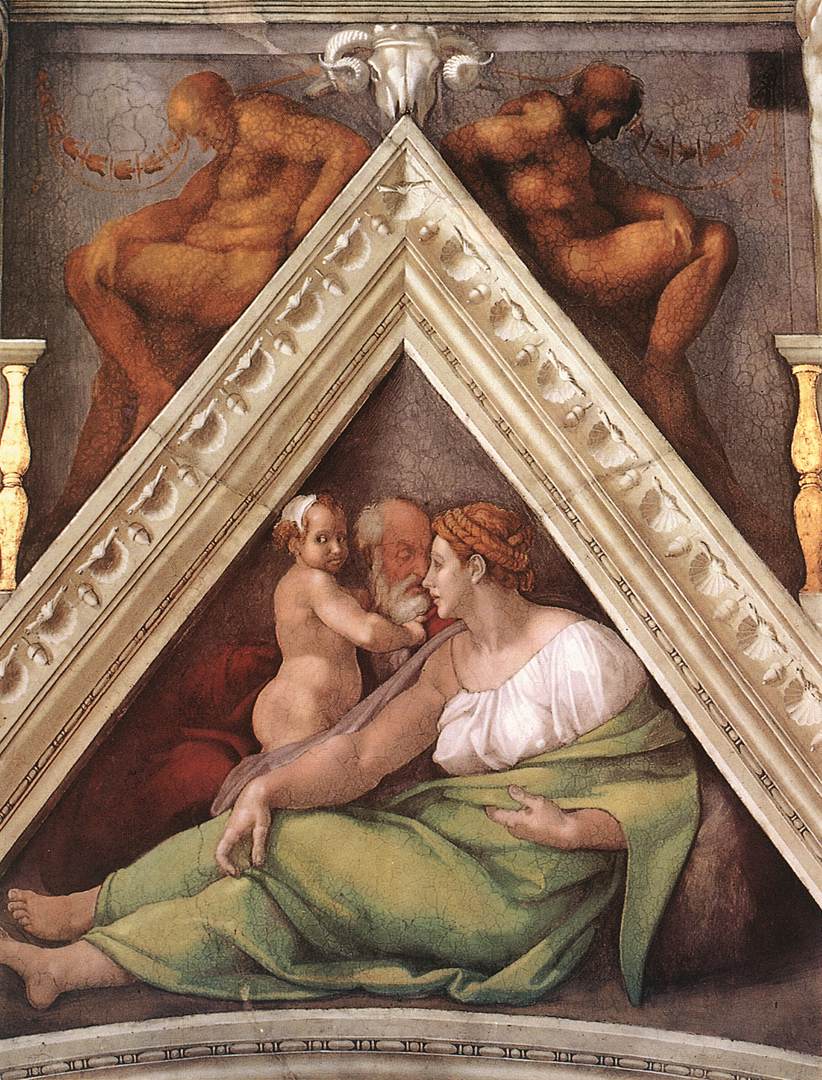

Michelangelo’s 1510 triangular spandrel above the Hezekiah–Manasseh–Amon lunette in the Sistine Chapel presents an infant with two adults, arranged within its architectural frame. The group is traditionally interpreted as Hezekiah with his parents; that is an artistic identification rather than a verified portrait. It is the spandrel, not the separate, wider lunette painted in 1511–12. This is a useful opportunity to ask what a painting adds to a genealogy: pose, gesture, age, clothing and proximity can make a family appear immediate even when the written list supplies only names and relationships.
Matthew 1:9–10 gives a succession of named generations. Second Kings gives additional identifying information about Hezekiah and his mother. Neither passage supplies the particular triangular composition, the adults’ postures or the child’s appearance. Those choices belong to the later visual work.
An interpretation may connect the fresco with an ancestor cycle and a set of names, while remaining careful about which figure is assigned each name. The reproduced group should not be called a verified historical portrait of Hezekiah with his biological parents merely because an older web caption uses that wording.
The purpose of comparing image and text is therefore concrete: distinguish what the biblical sources state, what an art source identifies, and what the viewer sees in the painted group. None of those steps establishes a total of 128 mentions or makes the artwork evidence for a numerical message in Psalm 128.
Sources and Reading Limits
- Primary reading, King James Version: Psalm 128:1–6; 2 Kings 18:1–8, 19:1–37 and 20:1–21; Matthew 1:1–17.
- The poem is read as a blessing with household and communal imagery. The Hezekiah passages and the genealogy answer separate questions.
- The art comparison distinguishes visible composition, object identification and biblical information. It does not establish a historical likeness or an original-language occurrence total.
- Artwork and exact composition: Michelangelo’s Ancestors of Christ: figures, 1510, Sistine Chapel. The source shows the triangular group within its surrounding architectural frame.
Return to reading Bible numbers in context.