Aaron at 123, a Prayer for Mercy and Reading a Biblical Painting
Numbers 33:39 states that Aaron was 123 years old when he died on Mount Hor. The surrounding narratives explain his death, the transfer of his garments to Eleazar and Israel’s mourning. Psalm 123 is a different kind of reference: its chapter number locates a four-verse appeal for mercy. A number used as an age should not be confused with a chapter label or a proposed total of occurrences of a name.
What Does the Age of 123 Describe?
Numbers 33:37–39 places Aaron’s death in an itinerary. Israel leaves Kadesh and camps at Mount Hor, on the edge of Edom. Verse 38 identifies the time as the fortieth year after the departure from Egypt, on the first day of the fifth month. Verse 39 then supplies Aaron’s age: “an hundred and twenty and three years old.” These are the passage’s own chronological markers.
An exact modern civil date or a BC year requires an additional chronology and calendar conversion. The passage does not state a July date or print the year 1406 BC. Its direct age statement can be explained without presenting those further calculations as quotations from Scripture.
Numbers 20 supplies the narrative setting. After the dispute over water at Meribah, the Lord tells Moses and Aaron that they will not bring the congregation into the land. Verse 24 explicitly connects Aaron’s death outside the land with rebellion at the water of Meribah. The account should therefore be read alongside the earlier scene, rather than reduced to an isolated lifespan statistic.
Why Does the Transfer of Garments Matter?
The account sends Moses, Aaron and Aaron’s son Eleazar up the mountain. Moses removes Aaron’s garments and puts them on Eleazar; Aaron dies there, and Moses and Eleazar come down. The congregation mourns Aaron for thirty days. The narrative joins an individual death with the continuation of priestly service.
| Passage | Detail stated | Reading consequence |
|---|---|---|
| Numbers 20:12, 24 | The exclusion from the land is connected with Meribah. | The death scene has a prior narrative setting. |
| Numbers 20:25–28 | Eleazar receives Aaron's garments before Aaron dies. | Succession belongs to the account, not just the age. |
| Numbers 20:29 | Israel mourns for thirty days. | The congregation's response follows the mountain scene. |
| Numbers 33:38–39 | The itinerary gives the year, month, day and age. | These stated markers can be distinguished from a modern calendar reconstruction. |
The texts do not make 123 a universal age of transition or prescribe it as a code for another person’s future. Its immediate referent is Aaron’s age at this event.
How Does Psalm 123 Move from Looking to Pleading?
Psalm 123 begins with eyes lifted toward the one dwelling in heaven. It compares the community’s waiting with servants looking toward their masters’ hands and a maiden toward her mistress’s hand. The comparison then becomes explicit: “so our eyes wait upon the LORD our God, until that he have mercy upon us.” The images lead into the repeated request for mercy.
| Verse | Movement | Detail to notice |
|---|---|---|
| 1 | The speaker lifts the eyes toward the Lord in heaven. | The direction of attention opens the prayer. |
| 2 | Servant and mistress imagery explains waiting for mercy. | The comparison moves from familiar relationships to “our eyes.” |
| 3 | Mercy is requested twice. | The prayer names the community's experience of contempt. |
| 4 | Scorn and the contempt of the proud close the complaint. | The prayer gives a reason for its appeal without naming a precise historical occasion. |
The poem’s comparison with servants is not a command endorsing mistreatment by a human master. Its stated comparison concerns eyes waiting for mercy. Likewise, the closing complaint should not disappear when the opening is used as a general encouragement to pray: contempt is part of what the speakers bring before the Lord.
Nothing in these four verses identifies Aaron’s death as the prayer’s occasion. Their shared number in a study directory does not create that connection.
Isaac's Blessing: What Can the Narrative Check?
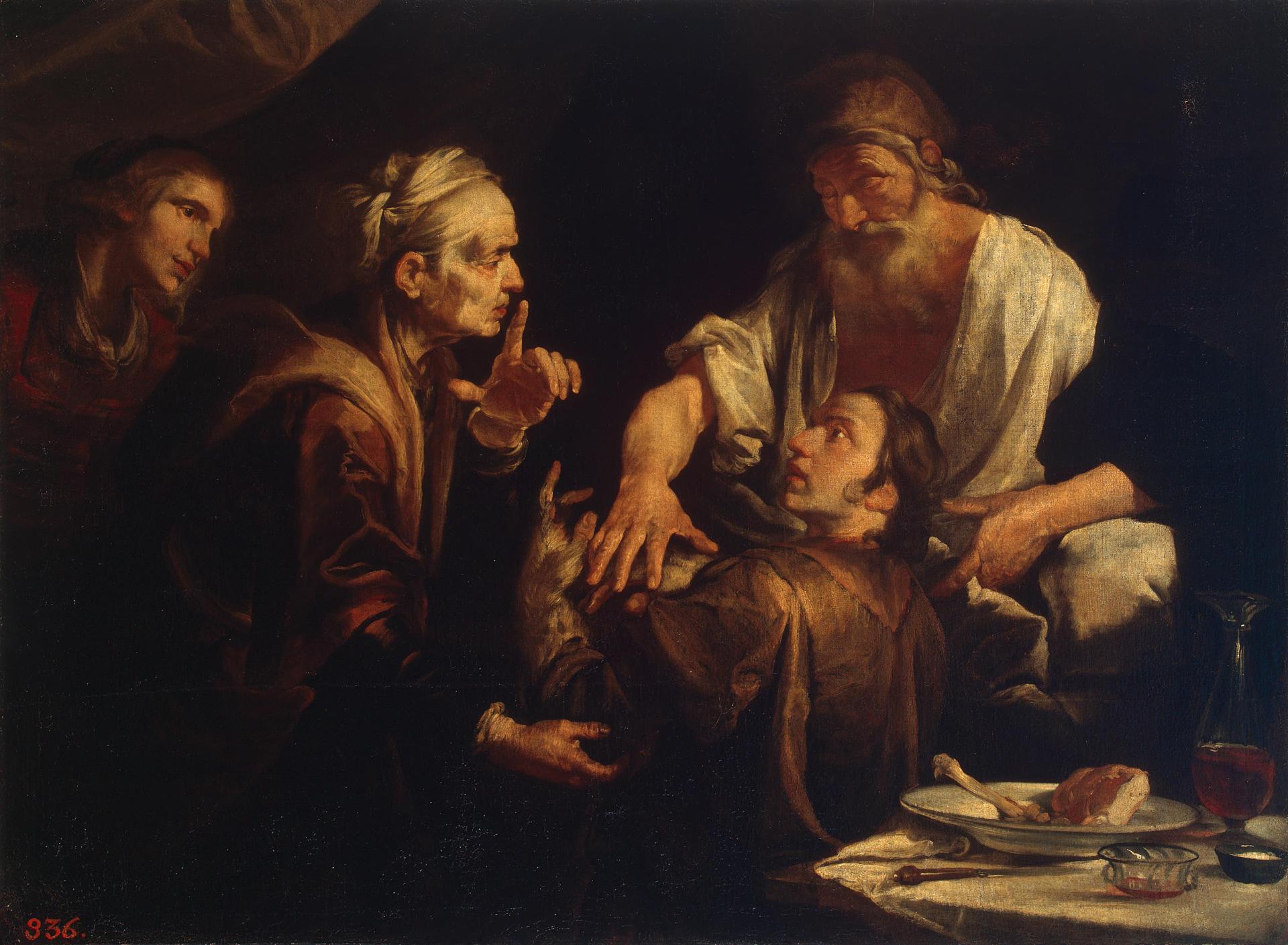

Gioacchino Assereto’s Isaac Blessing Jacob, dated to the 1640s and held by the Hermitage Museum, presents an aged man, a younger man close to him and a woman beside them, with a fourth figure farther left and a meal at the right. Hands, proximity and the older man’s face make it useful for asking how a painter condenses a story about uncertain recognition. A painting can draw attention to those details while remaining a later interpretation of the text.
Genesis 27 provides the narrative sequence. Isaac’s eyesight is dim; Rebekah hears his plan to bless Esau and prepares Jacob’s approach. Jacob wears Esau’s clothing and goat skins on his hands and neck. Isaac questions, touches and smells before giving the blessing. Verse 22 captures the uncertainty: “The voice is Jacob’s voice, but the hands are the hands of Esau.” Esau returns after Jacob has left, and the consequences include grief, anger and Jacob’s departure.
Genesis 28:1–5 then describes Isaac blessing Jacob openly and sending him toward his mother’s family. That is a related but distinguishable scene. Reading both chapters prevents every painted blessing gesture from being treated as a precise record of one moment, and prevents the departure blessing from being folded silently into the earlier deception.
The image cannot establish how often Isaac’s name occurs in a translation, Aaron’s age, the historical appearance of the participants or the architecture and clothing of their household. Its value here is to compare artistic selection with the actual narrative: which details help suggest the encounter, which parts of the sequence are absent, and which visual choices the biblical passage does not specify.
Sources and Reading Limits
- Primary reading, King James Version: Numbers 20:1–29; 33:37–49; Psalm 123:1–4; Genesis 27:1–46 and 28:1–22.
- Aaron’s age, the itinerary and the narrative of succession are distinguished from calendar conversions. Psalm 123 is read as its own prayer.
- The art comparison distinguishes a later visual interpretation from the sequence and limits of Genesis. No word-frequency total or historical likeness is inferred from the image.
- Artwork identification and full composition: Assereto’s Isaac Blessing Jacob, Hermitage Museum, inventory ГЭ-1457. The fuller composition includes a left-hand figure and tabletop details omitted by some crops.
Return to reading Bible numbers in context.