Jesus was buried in a new, rock-cut tomb associated with Joseph of Arimathea. John places the tomb in a garden near the crucifixion site, close enough to use as the preparation day drew to its end (John 19:38–42). These details explain why Christians speak of a garden tomb. They do not by themselves identify the modern Jerusalem visitor site called the Garden Tomb.
Where was the tomb in relation to Jerusalem?
John 19:20 says the crucifixion place was near the city; Hebrews 13:12 describes Jesus suffering outside the gate. John 19:41–42 then places the burial in a nearby garden. Together these passages give useful geographical relationships: city, execution place, garden and nearby tomb. They do not name the Damascus Gate, give a compass bearing or provide a street address.
Matthew calls Joseph a rich disciple and says he placed Jesus in his own new tomb, cut in rock (27:57–60). Mark describes Joseph asking Pilate for the body, wrapping it in linen and rolling a stone against the entrance (15:42–46). Luke says no one had previously been laid in the tomb (23:53). John adds Nicodemus and the burial spices (19:39–40). The accounts support a rock-cut burial place closed by a stone; they do not give an architectural floor plan or require every pictured stone at a modern site to be original.
Isaiah 53:9 links the suffering servant with the rich in his death. Christians read Joseph's burial of Jesus alongside that passage. Isaiah does not itself name Joseph, describe Jerusalem's gates or identify a modern property. The burial narrative supplies those connections to a rich man.
Why are two different Jerusalem sites discussed?
The Church of the Holy Sepulchre represents the longstanding church tradition of the death and burial site. The Garden Tomb represents a much later proposed identification. An early tradition deserves historical investigation; a visually evocative setting also deserves careful examination. Neither becomes certain simply because a visitor finds it moving.
| Site | What the source says | How far that evidence reaches |
|---|---|---|
| Holy Sepulchre tradition | In Life of Constantine III.25–40, Eusebius describes Constantine's removal of covering material, the discovery of a cave identified as Jesus' tomb, and the construction of a splendid church. | A fourth-century witness to the identification and building project. His theological certainty is not a modern excavation report or an eyewitness account of Jesus' burial. |
| Garden Tomb | The site's own account describes nineteenth-century proposals concerning a nearby skull-like rocky escarpment and a garden purchased in 1894. It presents the tomb as a possible burial location. | An account of the modern proposal and the custodians' qualified belief, not proof that this was Joseph's new tomb. |
Read Eusebius, Book III and the Garden Tomb's own explanation with their dates and purposes in mind. Eusebius writes in praise of Constantine and describes the recovered cave in devotional language. The Garden Tomb organization emphasizes worship and witness and acknowledges that its ministry does not depend on proving the precise location.
A wall on a present-day Jerusalem map is not automatically the wall referred to by a first-century account. A burial-site argument must establish the relevant ancient city's extent, rather than dismissing or accepting a candidate solely because of its position relative to today's walls.
Examine an actual photograph of the Garden Tomb
Open the Garden Tomb organization's photograph of the tomb entrance and garden, identified as “The Tomb” on its official page. The picture shows the modern visitor setting. Its value is that you can inspect a real rock face and entrance while recognizing the difference between a present appearance and an ancient identification.
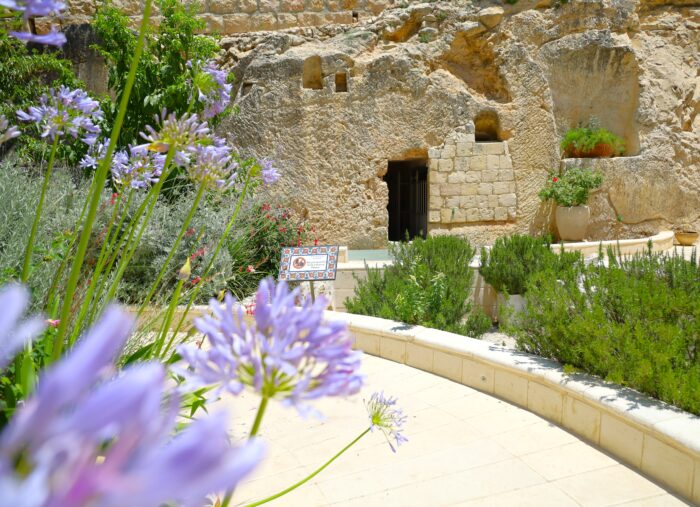
- Locate the opening. A dark doorway sits in the rock face, beside a section of fitted pale masonry. There is also a small opening higher in the face. Those visible features do not date the cutting of the tomb or identify its first occupant.
- Identify the modern setting. Flowers, planted beds, paving, a sign and the controlled entrance are visible. They help visitors approach the site, but are not evidence that this garden has remained unchanged since Jesus' burial.
- Notice what is concealed. This exterior view cannot establish the interior chamber plan, the age of burial benches or the original closure mechanism. Do not infer a complete reconstruction from the doorway or nearby stonework.
- Return to John 19:41–42. A garden and a rock-cut tomb make the narrative easier to picture. Ask the separate question: what dated evidence would connect this particular tomb to a burial around the time of Jesus? Visual resemblance alone cannot answer it.
Who went to the burial place?
The Gospels distinguish the burial, the women's observation and preparation, and the later visits associated with the empty tomb. Keeping those stages separate avoids creating a visit that a cited passage never describes.
| Stage | People and passages | Reading caution |
|---|---|---|
| Burial | Joseph appears in all four accounts; John also names Nicodemus (Matthew 27:57–61; Mark 15:42–47; Luke 23:50–56; John 19:38–42). | Combine complementary details without claiming each writer lists everyone present. |
| Observation and preparation | Matthew names Mary Magdalene and the other Mary; Mark names Mary Magdalene and Mary the mother of Joses. Luke describes the women seeing the tomb, preparing spices and resting on the Sabbath. | Luke 23:55–56 distinguishes seeing the burial place from resting afterward. |
| First-day visit | Matthew 28:1–10; Mark 16:1–8; Luke 24:1–12; John 20:1–18 describe visits and discoveries, with different details emphasized. | Mark 16:1 mentions buying spices after the Sabbath; it does not establish a late-Saturday visit immediately before the resurrection. |
| Disciples investigate | Luke 24:12 describes Peter. John 20:2–10 describes Peter and the disciple Jesus loved running to the tomb. | John does not give the other disciple's personal name in this passage. |
What would establish the exact location?
A serious identification needs more than a garden, a cave or a skull-like outline. Relevant questions include the date and original use of the tomb, its relation to the first-century city and execution area, changes to the landscape, and the history of the identification. Archaeology and historical testimony can inform these questions, but a photograph cannot supply missing dates or an occupant's name.
The strongest answer directly supported by the Gospels remains the relational one: Joseph's new rock-cut tomb, in a garden near the crucifixion place outside the city. The precise modern location requires a further historical argument. Keeping those levels distinct allows a visitor to study either site without treating a traditional label as an additional sentence of Scripture.
Sources and study notes
Scripture was checked in the King James Version, especially Matthew 27:57–28:10, Mark 15:42–16:8, Luke 23:50–24:12, John 19:17–22 and 19:38–20:18, Hebrews 13:11–14 and Isaiah 53:8–9. The historical comparison uses Eusebius, Life of Constantine III.25–40, and the Garden Tomb organization's account of its site. These sources have different purposes and do not provide an independent archaeological authentication of the photographed tomb. The photograph is linked at its original source.