Onyx in the Bible: Engraved Memorials, Temple Gifts and Sardonyx
The KJV calls the stones engraved with Israel's tribal names onyx, and also includes onyx among the materials David prepared for the temple. These are particular uses in particular passages. They do not settle the modern mineral identity of the Hebrew word shoham, or make every object now called onyx a biblical specimen.
Where Does Shoham Occur?
| Passages | Setting | What to notice |
|---|---|---|
| Genesis 2:12 | Resources associated with Havilah | Gold, bdellium and the onyx stone appear in the description surrounding Eden's rivers |
| Exodus 25:7; 35:9, 27 | Materials for the sanctuary | Stones are requested and brought for the ephod and breastplate |
| Exodus 28:9; 39:6 | Engraved shoulder stones | Israel's names are cut into stones set in gold |
| Exodus 28:20; 39:13 | The breastplate's fourth row | Onyx occupies the middle position in the KJV's row of beryl, onyx and jasper |
| 1 Chronicles 29:2 | David's preparations for the temple | Onyx is included among contributed building and furnishing resources |
| Job 28:16 | The value of wisdom | Precious onyx and sapphire cannot equal wisdom |
| Ezekiel 28:13 | A lament over the king of Tyre | Onyx is one of the precious stones in the lament's richly adorned description |
Genesis names a resource; it does not give a modern mine location or mineral analysis. Job uses value to make a comparison, rather than teaching that a stone gives wisdom. Ezekiel 28:12 expressly introduces a lament over the king of Tyre. An interpretation of its Eden imagery should be distinguished from the passage's stated addressee.
Shoulder Stones and Breastplate Stones Are Different Settings
Exodus 28:9–12 describes two shoulder stones engraved with the names of Israel's sons: six names on one and six on the other, according to their birth. They are set in gold and placed on the ephod's shoulders as memorial stones. Aaron bears the names before the Lord. Exodus 39:6–7 describes the work carried out.
The breastplate has a different arrangement: four rows containing twelve stones, with names engraved on them (Exodus 28:17–21). Onyx appears in the fourth row in the KJV. Its row position should not be used to replace the explicit six-and-six description of the shoulder stones, or to invent a tribal assignment that this list does not supply.
In 1 Chronicles 29:1–9, David describes preparations for the house his son Solomon is to build. His list includes metals, timber, onyx and other stones; other leaders also give resources. This explains why onyx belongs in the account: it is part of the costly provision for the temple. The passage does not claim that onyx controls passion or relationships.
How Certain Is the Name Onyx?
The labeled lexical entries for H7718, shoham, preserve uncertainty. Strong's proposes a root connected with blanching but qualifies both derivation and identification; the NAS entry says “perhaps onyx,” and Brown–Driver–Briggs calls the identification dubious. A proposed etymology is therefore not a reliable color test for a specimen.
Revelation 21:20 uses a different word: sardonyx, G4557, for the fifth foundation of New Jerusalem. Thayer describes a red-and-white stone combining sard and onyx. This Greek foundation name should be read as its own term, rather than as proof that every Hebrew shoham passage refers to the same modern material.
Bands, Polished Surfaces and a Documented Cameo
In modern mineral terminology, the Minerals.net chalcedony reference describes chalcedony as microcrystalline quartz. It lists onyx as black or black-and-white banded material, and sardonyx as material with parallel brown or red bands alternating with white, sometimes also black. These modern descriptions help compare appearance; they do not remove the uncertainty surrounding the ancient Hebrew name.
For a specific worked example, compare the Metropolitan Museum of Art's Head of Hercules, accession 40.20.19. The museum's official catalogue record identifies its medium as sardonyx and dates it to the mid-19th century. In the corresponding museum photograph, a pale, warm-colored bearded head stands in relief against a red-brown oval field.
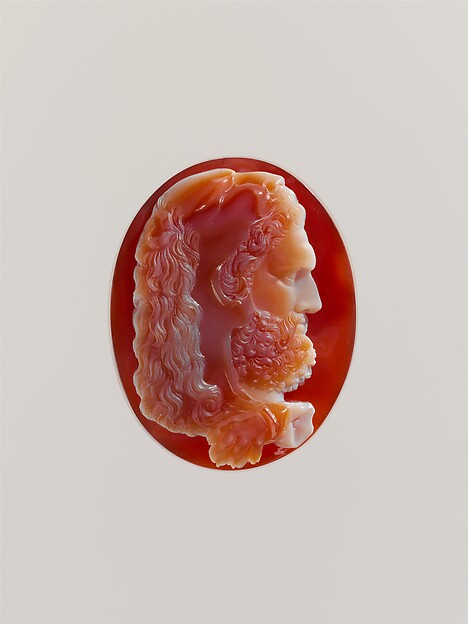
- Compare color: notice the contrast between the head and its background, rather than treating the whole object as one flat color.
- Compare form: the projecting face, hair and beard show the use of a stone for relief carving, a different visual task from identifying bands in an uncarved specimen.
- Keep the limits clear: a photograph does not establish the chemistry of each colored area. This documented later cameo is an example of worked sardonyx, not an object from the biblical sanctuary.
The useful comparison is between material description and a documented worked object. Neither provides evidence for a stone's supposed power to cool love, create discord or separate couples.
Sources and Further Study
- Scripture, KJV: Genesis 2:8–14; Exodus 25:1–9; 28:9–30; 35:1–29; 39:1–21; 1 Chronicles 29:1–9; Job 28; Ezekiel 28:1–19; Revelation 21.
- H7718, shoham, and G4557, sardonyx: labeled lexical entries and concordances, with the stated identification limits retained.
- Minerals.net, Chalcedony: modern material and band descriptions.
- Metropolitan Museum of Art, Head of Hercules: official object metadata; the linked museum photograph supplies the visual comparison.
- Continue with the breastplate's rows and memorial function, New Jerusalem's foundation names, or the gemstone study guide.
Prepared by the LetsLearnTheBible.com editorial team. Modern material names and the museum object are comparison aids; they do not certify the mineral identity of a biblical stone.