Tarot cards are illustrated playing cards that can be used for games or for readings intended to disclose hidden meaning or the future. Those uses deserve separate consideration. The Bible does not name tarot cards; a Christian judgment about divination applies biblical teaching to a practice developed much later.
Meaning and historical origins
The Victoria and Albert Museum's history of tarot describes surviving fifteenth-century Italian cards associated with courtly play. Their pictures included familiar social and religious figures. Fortune-telling and occult reinterpretations became attached to tarot in the eighteenth century and developed further afterward. The museum notes that claims of ancient Egyptian origins remain unproven.
This sequence matters: evidence for an early card game is not evidence that every game was secretly a divination ritual. Conversely, a deck's origin in play does not settle whether every later use is appropriate. The unsupported claim that “tarot” means “tablets of destiny” is unnecessary to explain either its history or the biblical question. Cartomancy is fortune-telling with cards; it describes a use, rather than proving that cards can disclose the future.
What is in a tarot deck?
A familiar 78-card format includes 22 cards commonly called the major arcana and 56 called the minor arcana. The latter are divided into four suits, often swords, cups, coins or pentacles, and batons or wands. Pictures, names and arrangements vary between decks. These categories describe the pack; they do not demonstrate a spiritual power in its paper or printing.
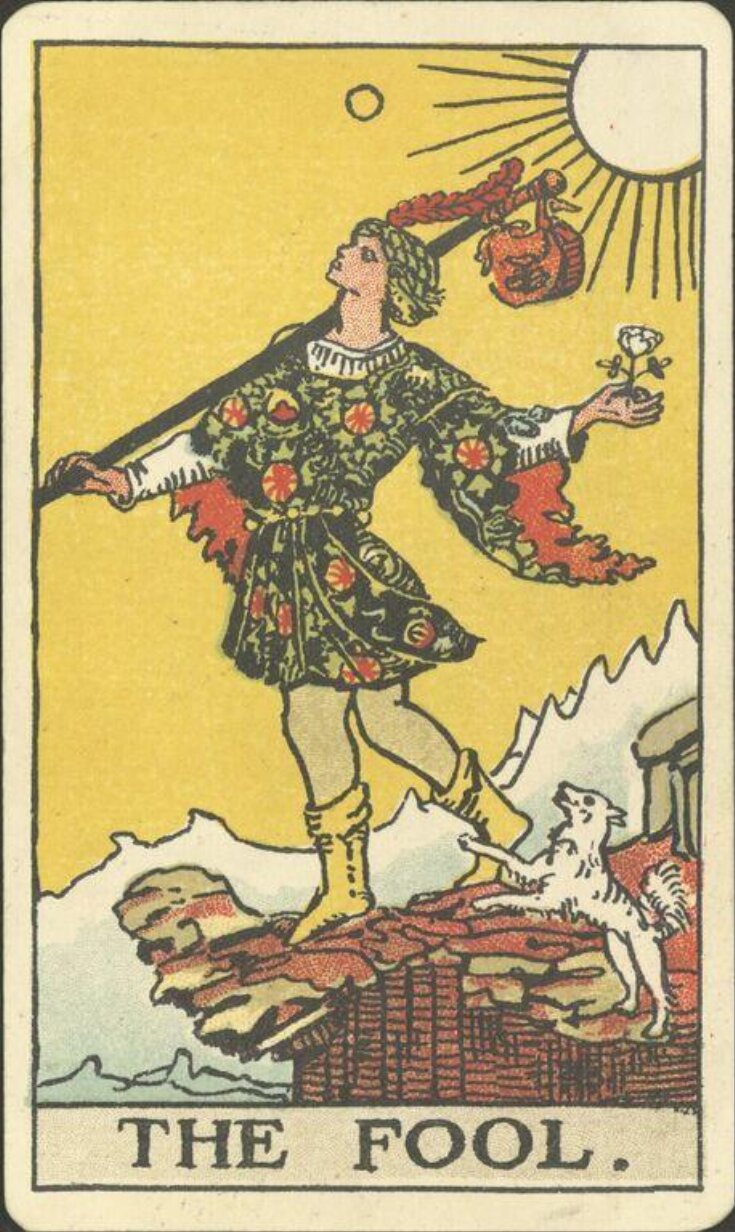
- Look for the number 0 above the figure and the title below. Notice the yellow background, bundle, white rose, small dog and cliff edge.
- Distinguish visible objects from a reading imposed on them. Seeing a dog or a cliff is an observation; saying the picture predicts a particular person's journey is an additional claim.
- Use the catalogue to identify this specific work. One illustrated card does not show all 78 cards, prove an ancient Egyptian origin or establish that every deck has identical pictures.
Games and readings
| Use | What the cards are doing | Question to ask |
|---|---|---|
| A card game | Cards take values within agreed rules; trumps can outrank other cards. | Is anyone treating the result as a revelation or command? |
| Art or historical study | Pictures, makers and surviving objects are examined. | Does the interpretation follow the actual object and documentation? |
| A divinatory reading | Selected cards are interpreted as guidance about hidden matters or the future. | Is spiritual authority being assigned to the cards or their interpreter? |
| Reflection using a picture | An image prompts a thought or story. | Is this a human association, or a claim to knowledge beyond ordinary evidence? |
Putting these activities under one name can conceal the difference between playing a game and seeking an oracle. The table offers distinctions for evaluating a particular activity; it does not establish how many people follow each approach or certify a reader's claims. A spread of cards cannot verify someone's honesty, spiritual condition or future merely by its appearance.
What does the Bible address?
Deuteronomy 18:9–14 addresses Israel as it enters the land and forbids practices including divination and consulting the dead. Leviticus 19:26, 31 and 20:6–8 likewise warn against seeking guidance from forbidden spiritual sources. The link to a modern tarot reading is therefore an application: when cards are used to seek occult knowledge or spiritual direction, that use fits the kind of practice these texts reject. The passages do not discuss an Italian deck by name.
Isaiah 8:19–22 contrasts turning to mediums and the dead with seeking God and attending to his teaching. Its concern is where people turn for authoritative guidance. That gives a Christian reason to reject a claimed oracle without inventing a story about how every particular reader obtains information.
Leviticus 20:27 prescribes a capital penalty within ancient Israel's law. Reading that text in its historical setting does not authorize modern readers to threaten, punish or harm card users. A discussion of Christian discernment should explain the prohibition without turning it into a personal license for violence.
Nor does 2 Corinthians 4:1–6 establish that every tarot practitioner is knowingly lying or possessed. Paul discusses the gospel, spiritual blindness and the integrity of his ministry. Applying a general warning about deception requires care; it is not evidence about an individual whom the writer has never met.
Evil or harmless amusement?
The physical cards and their use are different questions. Examining a museum object or playing a game does not automatically involve consulting spirits. Yet calling a reading “just entertainment” does not resolve the concern if a person actually relies on it as supernatural instruction, a prediction or a way to contact the dead. The Christian objection in this article concerns that appeal to divination, rather than the mere existence of illustrated cardstock.
Ask what authority is being claimed: are the pictures being studied, used under game rules or treated as a source of hidden truth? A reader's confidence or an emotionally striking image does not by itself establish divine guidance. Christians can decline divinatory readings without assuming they know the motives of every player, artist or collector.
Proverbs 1:1–7 and 2:1–11 connect wisdom with reverence for God, learning, instruction and discernment. James 1:2–8 encourages those facing trials to ask God for wisdom. These passages support prayer, Scripture and thoughtful counsel as a Christian response to uncertainty. They offer a positive direction without promising that a believer will receive a prediction of every event.