The familiar circle with a vertical line and two downward branches began as a British nuclear-disarmament emblem in 1958. Its designer was Gerald Holtom. A dove with an olive leaf and a hand making a V can also communicate peace, but each has a different history. Identifying the shape before interpreting its message helps avoid confusing those histories.
Read the circle and its lines
The Campaign for Nuclear Disarmament's history of the design explains the initials: N for nuclear and D for disarmament, represented using flag semaphore. This is a system in which the positions of two flags communicate letters. The circle surrounds the combined strokes; the letters themselves are represented by the lines inside it.
| Letter | Flag positions | Lines to notice |
|---|---|---|
| N | Both arms extend diagonally downward, one to each side. | The two downward branches. |
| D | One arm points straight up and the other straight down. | The continuous vertical stroke. |
| Combined | Superimpose the positions rather than trying to make both letters at once. | The vertical stroke and two branches within a circle. |
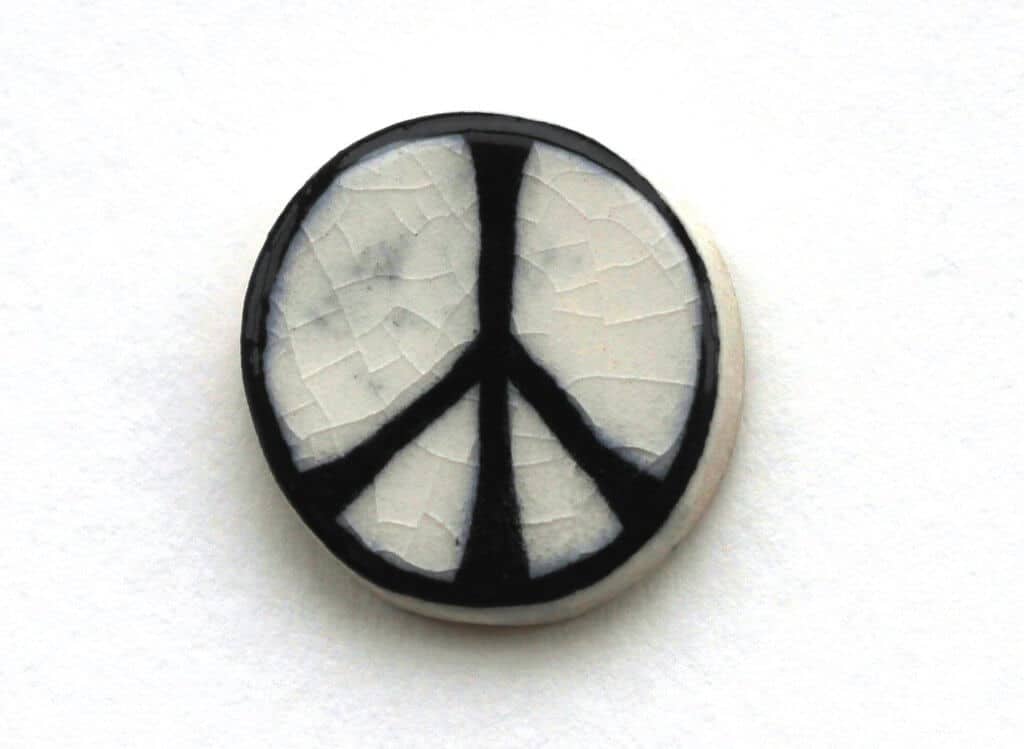


- On the badge, locate the black circle, uninterrupted upright line and two downward diagonal branches. The pale, visibly cracked surface belongs to a physical badge, rather than a modern drawing of flags.
- Compare N's two low flag positions with D's up-and-down positions. Ignore the flags' colors when tracing the emblem: it is their positions that explain the strokes.
- Separate observation from documentation. The photograph shows the design and material surface; CND's historical account supplies its attribution and early use. The image alone cannot identify everyone who later wore the symbol or their beliefs.
Who created it, and why?
CND identifies Holtom as the designer and places the emblem's first public appearance on the Easter 1958 march from London to Aldermaston, the British nuclear-weapons establishment. The march was organized by the Direct Action Committee. The design's original purpose was therefore specific: opposition to nuclear weapons. Describing its origin only as a 1960s American antiwar fashion misses that earlier British setting.
Letters and recollections also give the design a personal dimension. CND reproduces Holtom's explanation to Peace News editor Hugh Brock: he associated the downward arms with his own despair and with a figure facing a firing squad in Goya's art. The semaphore explanation and this personal account need not compete. One describes the encoded initials; the other explains the emotional meaning he attached to the form.
How does the V sign differ?
The two-finger gesture and Holtom's printed emblem have separate documented histories. Imperial War Museums traces the wartime V campaign to a January 1941 BBC broadcast by the Belgian politician Victor de Laveleye. V joined the French word for victory with the Flemish word for freedom. Churchill adopted it in July 1941 and helped popularize the two-finger form; this does not mean he invented every earlier use of a V-shaped gesture.
The wartime campaign also used the Morse-code sound for V: three dots followed by a dash. That is different from the flag semaphore used in Holtom's design. A V gesture can communicate peace in another setting, while a victory photograph may be celebrating success in war. In ordinary conversation people call both a “peace sign.” The expression alone is not precise enough to establish which shape or meaning is intended.
Later meanings and origin claims
CND describes its emblem's wider use as a shorthand for peace and hope, including uses beyond its own campaign. A recognizable design can acquire new associations without changing the circumstances of its invention. To interpret a particular display, consider its caption, event and speaker rather than assigning every wearer the same political or religious beliefs.
Claims that Holtom copied a secret ancient anti-Christian emblem require evidence connecting that alleged source to his work. Visual resemblance by itself does not provide that connection. CND's account instead points to his letters, interviews and original sketches in Bradford's Commonweal Collection. His documented 1958 design history should not be replaced with an unsupported story about Nero or ancient occult origins.
The dove and biblical peace
A dove carrying an olive leaf belongs to a different symbolic tradition. In Genesis 8:6–12, Noah sends birds to learn whether the floodwaters have subsided. The dove returns with a freshly plucked olive leaf; later it does not return. The passage describes evidence of receding water and renewed life. It does not introduce Holtom's emblem or call the bird a nuclear-disarmament sign.
Matthew 3:13–17 and John 1:29–34 describe the Spirit descending like a dove at Jesus' baptism. Their subject is Jesus' identity and the Spirit's testimony, rather than an instruction that every drawing of a dove has one fixed meaning. Neither those passages nor Genesis makes the dove the historical source of the 1958 circle-and-lines design.
For Christian conduct, the clearest emphasis is on making peace: Jesus blesses peacemakers in Matthew 5:9, and Romans 12:14–21 calls believers to reject revenge, help enemies and pursue peace as far as they can. Displaying a symbol cannot substitute for those actions. Understanding its history can prevent a mistaken accusation; treating people peaceably puts the biblical teaching into practice.